
October 25, 2026
Exhibitions
Exhibitions
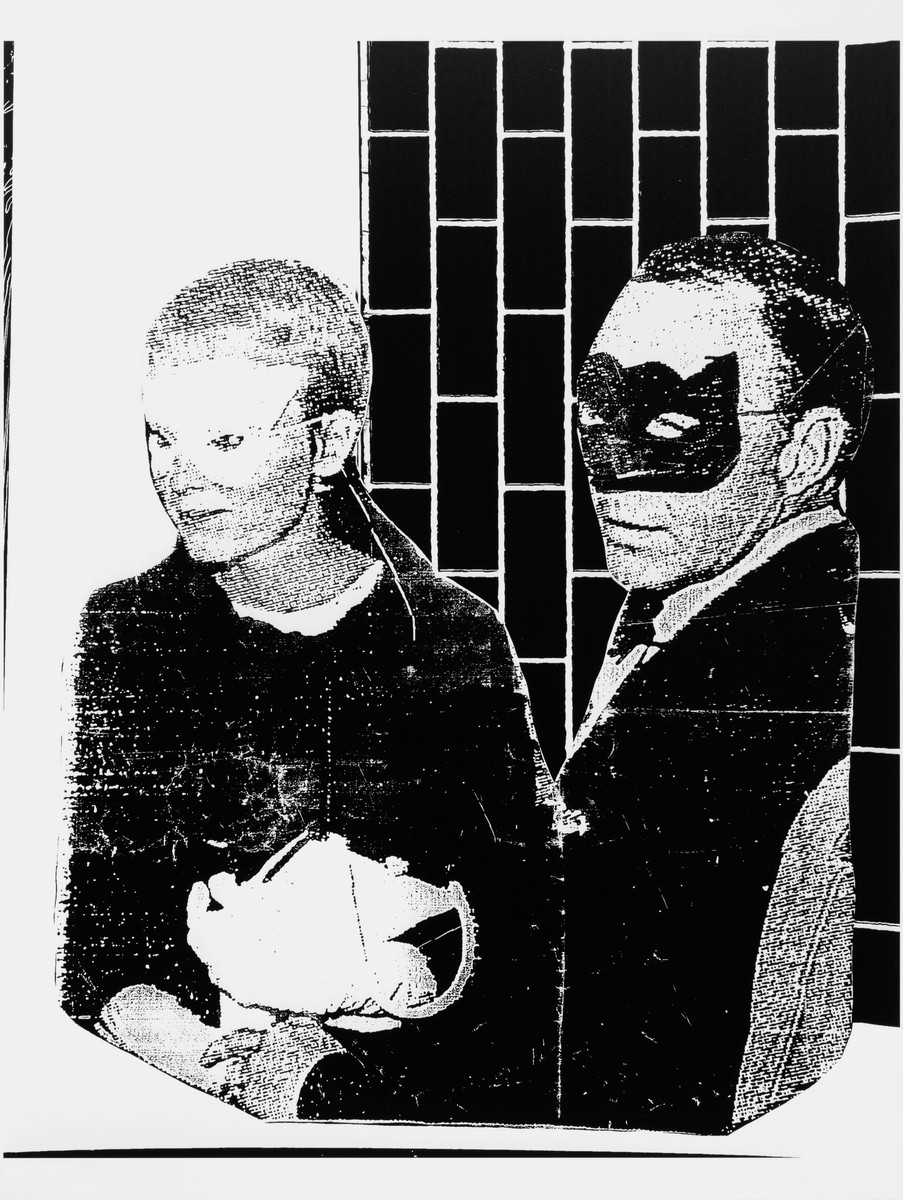
A rare London exhibition of new works and historical material returns us to Cady Noland’s uncomfortable vision of American spectacle, power and the ordinary object.
As CHART and Enter Art Fair open across Copenhagen, the strongest reason to visit is the art beyond the headline events: Camille Henrot at Copenhagen Contemporary, Ayako Rokkaku across fair and public space, Emma Kohlmann at V1, Anna Munk at Nicolai Wallner, Janaina Tschäpe at Galleri Bo Bjerggaard and more.
Copenhagen Art Week 2026 is bigger than the two fairs that give the week its commercial centre of gravity. CHART and Enter Art Fair both run from 27–30 August, bringing collectors, galleries and curators into the Danish capital at the same moment. But the most rewarding way to navigate the city is not to treat the fairs as self-contained destinations. It is to follow artists across booths, gallery exhibitions, institutions and public space.
CHART returns to Kunsthal Charlottenborg with 37 participating galleries and a deliberately Nordic focus. Enter, by contrast, brings a more international field: current gallery material for the 2026 edition describes 88 galleries from 20 countries and 43 cities at Lokomotivværkstedet. The contrast is useful. CHART offers a concentrated view of the Nordic gallery ecosystem; Enter allows that scene to be compared against a broader commercial map.
Yet Copenhagen’s real advantage this week is proximity. Camille Henrot can be seen at institutional scale at Copenhagen Contemporary. Ayako Rokkaku appears at Enter while simultaneously occupying the public realm beneath Nørrebro Station. Emma Kohlmann can be encountered in V1 Gallery’s CHART presentation and then in a full solo exhibition at the gallery. Anna Munk, Janaina Tschäpe, Frances Goodman and Maria Wæhrens all have substantial exhibitions opening in the same late-August window.
For collectors, that makes Copenhagen unusually legible. A work seen in a booth can be tested against a larger body of work within hours.
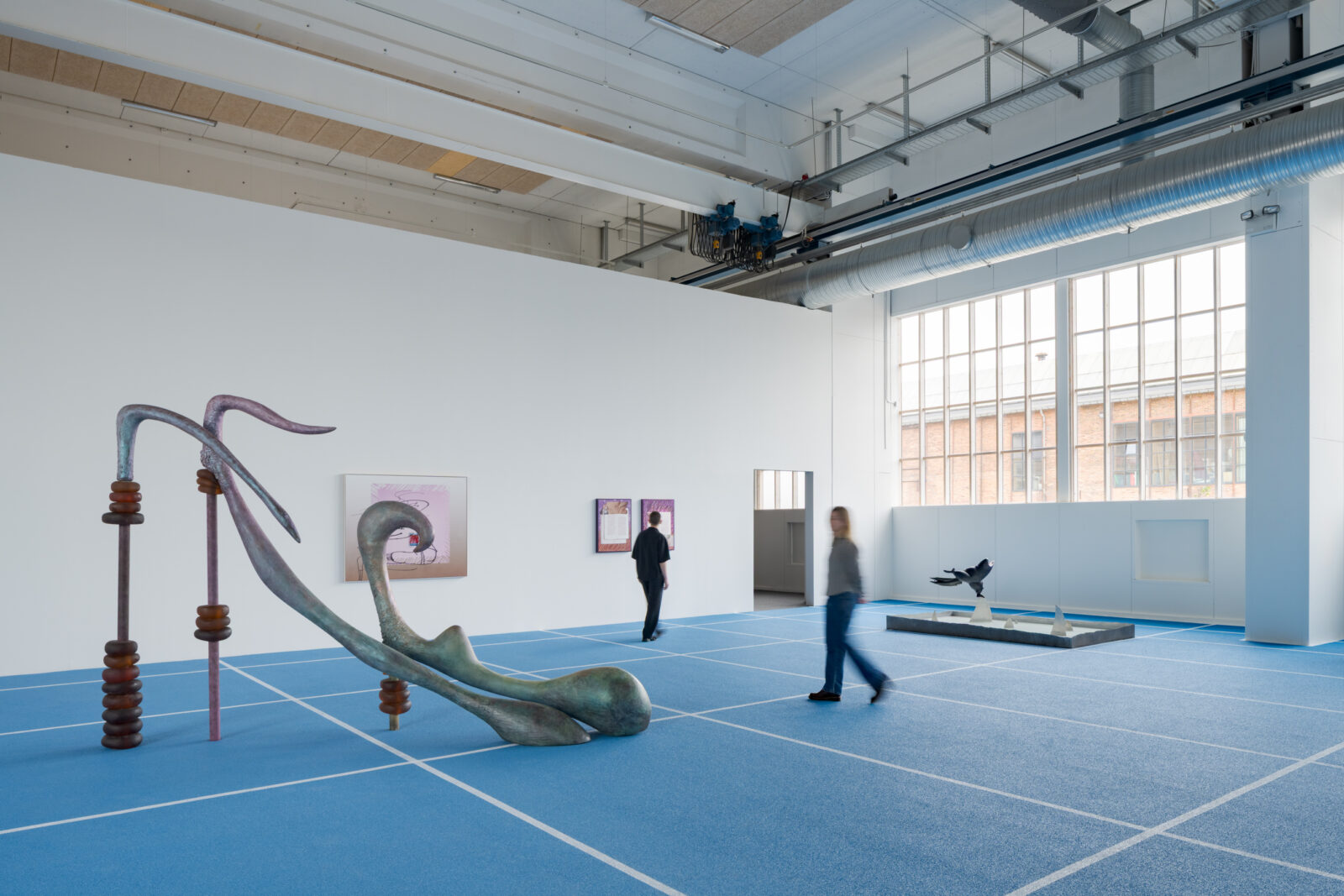
If fair week encourages speed, Camille Henrot’s Paper Planes offers the opposite. On view at Copenhagen Contemporary through 31 December 2026, it is Henrot’s largest solo exhibition in Scandinavia to date and brings together sculpture, drawing, installation and film, including the Scandinavian premiere of her 2026 film In the Veins.
Henrot’s practice has long been interested in the systems people construct to organise existence: rules, habits, technologies, social codes, self-help structures and archives. Her work is often funny precisely because those systems promise clarity and rarely deliver it. At Copenhagen Contemporary, drawing becomes a connective tissue rather than a secondary medium. It is a way of thinking through repetition, association and uncertainty, and the installation allows those ideas to spread into three dimensions.
This matters during an art fair because the conditions are almost perfectly opposed. A booth rewards immediate recognition. Henrot’s work rewards time. The sculptural forms can read almost diagrammatically at first, then become bodily and unstable as the viewer moves among them. The film and drawings make the installation less a sequence of objects than an accumulating mental environment.
For collectors, Paper Planes is a useful scale test. It asks whether a practice remains convincing when the market’s usual framing devices are removed. Henrot’s does — and that makes Copenhagen Contemporary an essential stop rather than an optional museum detour.
“The best way to use Copenhagen this week is to see the fair booth as the beginning of the conversation, not its conclusion.”
Ayako Rokkaku provides one of the clearest examples of why the city should be read as a network rather than an itinerary of isolated venues. At Enter Art Fair, Copenhagen gallery Collaborations is presenting her at booth 66 alongside Blair Saxon-Hill, Johanna Dumet and Monira Al Qadiri. A few kilometres away, however, Rokkaku’s visual language has been pushed to an entirely different scale.
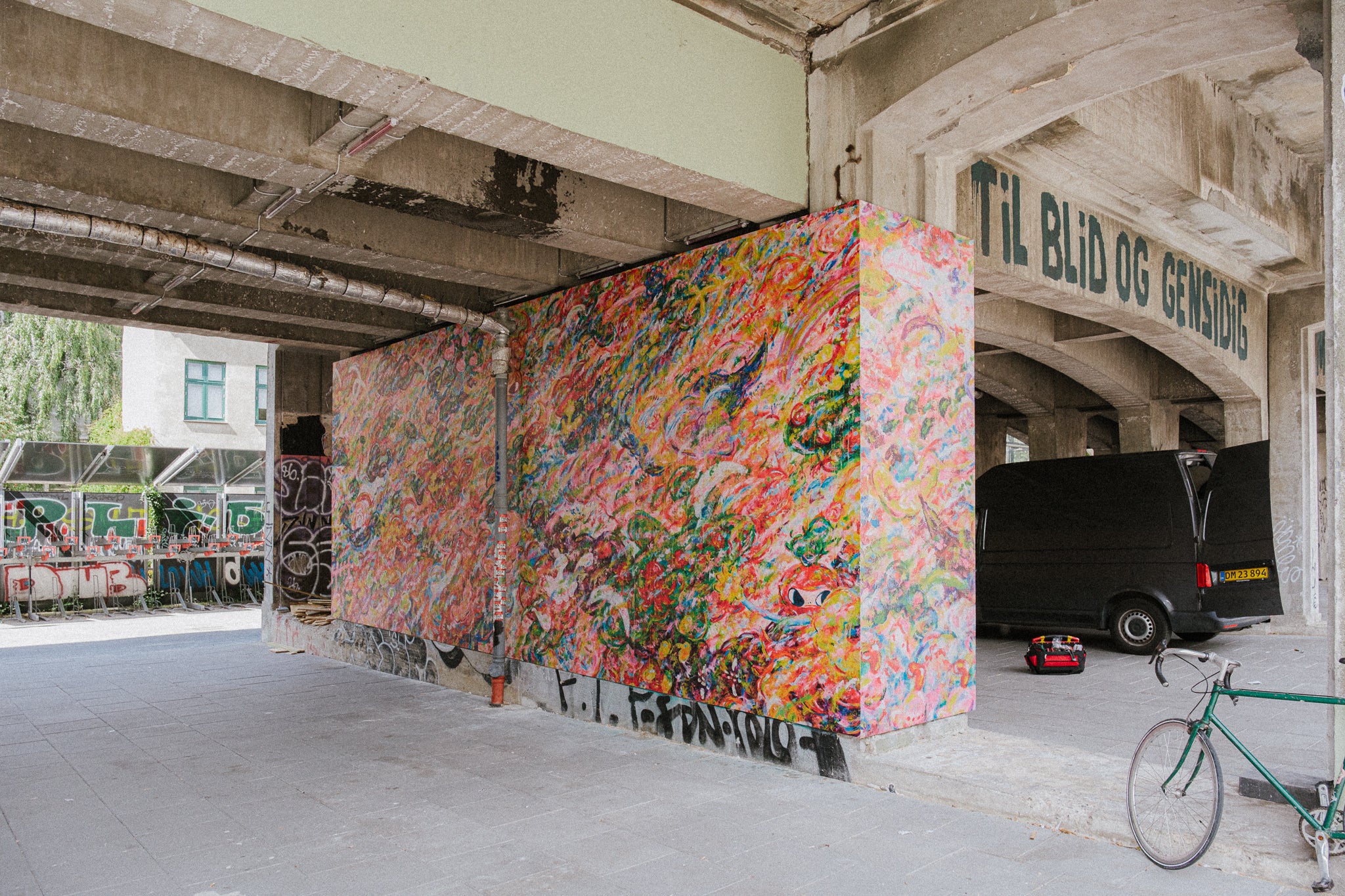
Since 19 August, a monumental work by the Japanese artist has occupied the public space beneath the elevated railway at Nørrebro Station. Originally conceived for Shibuya Station in Tokyo, the project brings Rokkaku’s gestural colour, dreamlike figures and hand-driven painting language into the concrete infrastructure of the city. KÖNIG GALERIE states that the work remains on view into mid-October.
Rokkaku’s physical method is central to the effect. She is known for applying acrylic directly with her hands, translating bodily movement into colour and figure. On canvas, that touch can feel intimate and immediate; enlarged into an urban environment, it becomes architectural.
The Enter presentation is therefore more interesting when seen in relation to Nørrebro. A collector can compare an object intended for a commercial setting with the same artist’s capacity to command civic space. Rokkaku is also included in I CAN BUY MYSELF FLOWERS at Kunsthal n through 13 September, creating a rare three-part encounter across fair, exhibition and public project.
CHART’s strength is concentration. The 2026 exhibitor list includes Galerie Nordenhake, i8 Gallery, Galleri Nicolai Wallner, Galleri Bo Bjerggaard, Galerie Forsblom, Galleri Susanne Ottesen, Helsinki Contemporary, Martin Asbæk Gallery, V1 Gallery and other established and younger Nordic programmes. But one booth is particularly useful for understanding how Copenhagen galleries are thinking beyond the standard fair hang.
V1 Gallery’s presentation, Nu går våren gennem Nyhavn, is conceived as an ode to Copenhagen’s famous inner harbour. The booth includes a custom-built viewing terrace and an artist-designed souvenir shop offering limited-edition objects, making the commercial and touristic mythology of Nyhavn part of the presentation itself.
The works move between humour, folklore, port imagery, craft and contemporary painting. Emma Kohlmann contributes a 2025 watercolour and sumi-ink work; Loji Höskuldsson is represented by 193 Days in Stockholm (Kräftskiva Party with an Even Bigger Splash), embroidered in wool on burlap; Rose Eken’s Sailor’s Meal, 1770 is glazed stoneware; Mads Hilbert’s large Kanalpisser brings a more irreverent energy. Works by Danny Fox, Misaki Kawai, Monica Kim Garza, Søren Behncke, Richard Colman, HuskMitNavn and others extend the harbour theme without turning it into a literal illustration exercise.
It is exactly the sort of fair presentation that rewards a second look. The booth has an argument, not simply an inventory.
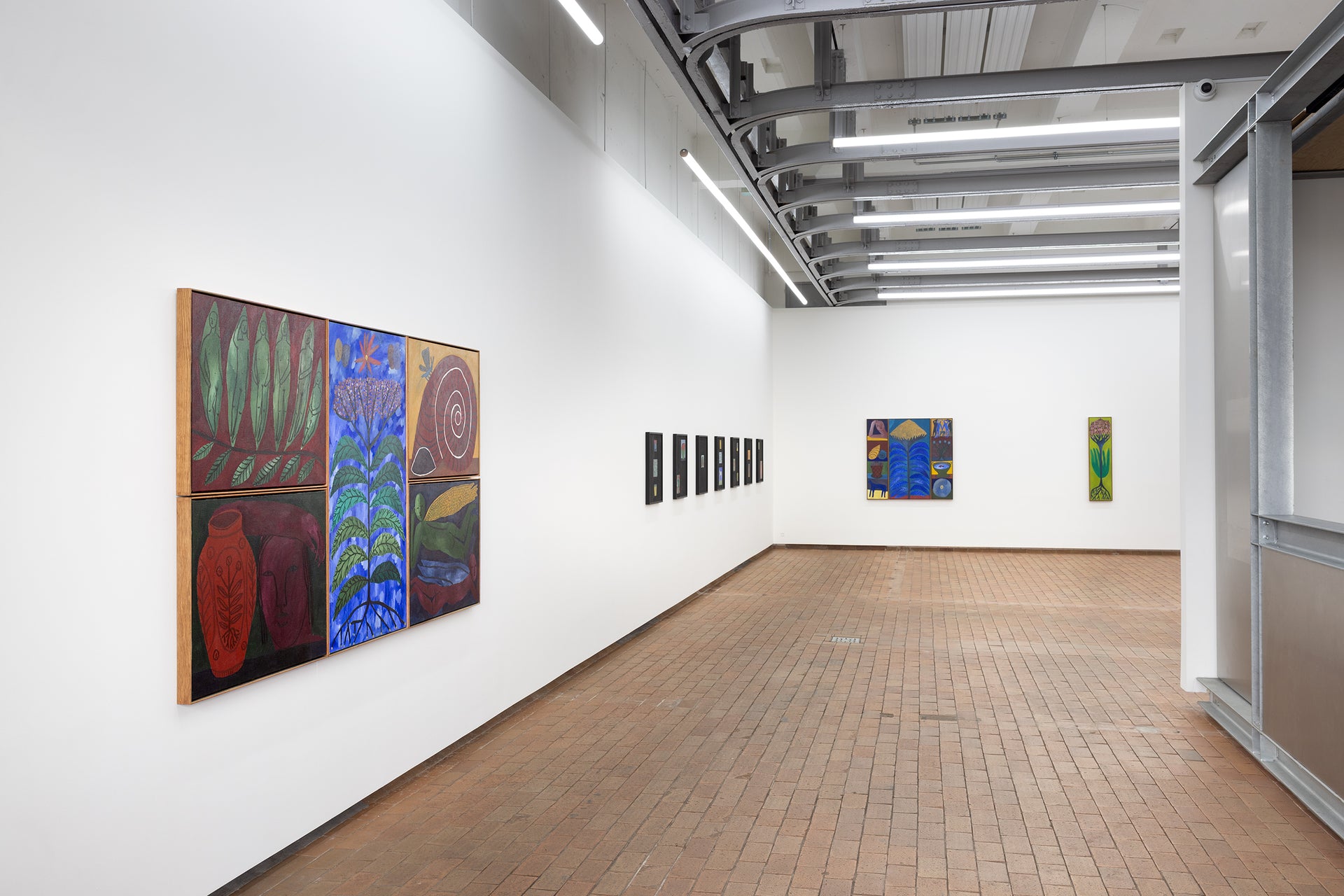
Kohlmann’s presence at CHART becomes more useful because The Messenger, her solo exhibition at V1 Gallery, opened on 21 August and runs through 26 September. Her work builds a contemporary mythology of hybrid bodies, plants, animals, faces and symbolic forms whose relationships remain deliberately unresolved.
The exhibition moves toward the figure of the messenger or angel, but Kohlmann’s images resist the smooth spiritual reassurance normally attached to those motifs. Her beings slip between categories. Human and animal forms overlap; landscapes become psychological; faces emerge from plant-like structures. The paintings and works on paper feel less like illustrations of a story than fragments of a cosmology whose rules are only partially available to the viewer.
That is precisely why seeing the gallery exhibition matters. The CHART watercolour can be read as a self-contained object, but at V1 it becomes one note within a larger visual system. Scale, repetition and variation begin to matter. For collectors already familiar with Kohlmann’s works on paper, the Copenhagen show offers a clearer sense of how her language is expanding.
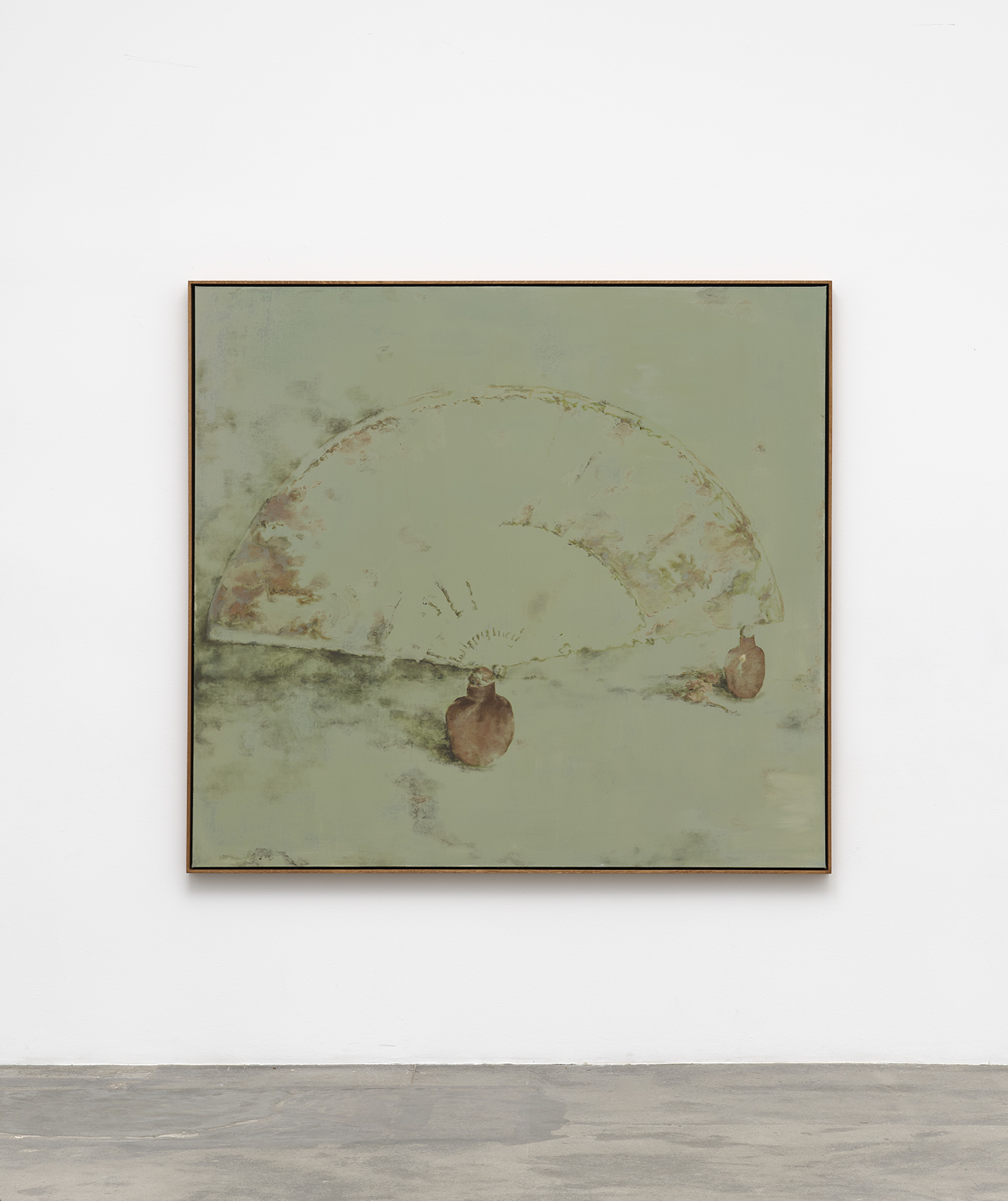
One of the week’s most interesting younger painting propositions is Anna Munk’s Ombres at Galleri Nicolai Wallner, on view from 21 August to 26 September. It is Munk’s first exhibition with the gallery and consists of seven large still-life paintings.
Each begins with two sources: a historical still life and a colour palette from Chanel eyeshadow. From there, the material distinctions begin to collapse. Powdered marble, rabbit-skin glue, oil, wax, varnish, eyeshadow and museum image archives all become part of the process. The cosmetics are not simply references to beauty culture; they alter surface, reflection and colour in the paintings themselves.
Bois Noir uses rabbit-skin glue, pigment, oil, varnish, eyeshadow and wax on jute to produce a near-monochrome darkness in which the still life almost disappears. Blurry Green uses oil, wax and eyeshadow and deliberately destabilises its source composition, recalling it in mirrored form. Across the exhibition, vessels, food and decorative motifs move in and out of legibility until the still life begins to behave like abstraction remembered imperfectly.
The historical genre is an intelligent choice. Still life has always been implicated in ownership, display, luxury, decay and the social life of objects. Munk reintroduces those questions through contemporary materials associated with beauty, branding and bodily presentation. The result is more subtle than a simple collision of Old Masters and Chanel: the paintings ask how cultural value survives after an image has been digitised, reproduced, marketed and remembered.
Collectors interested in contemporary painting should spend time with the surfaces rather than judging them from installation photographs alone. This is a materially specific practice, and much of its intelligence lives in the shift between matte, gloss, transparency and residue.

At SPECTA, Frances Goodman’s Peroral is one of the week’s sharpest combinations of material pleasure and conceptual wit. The exhibition, on view from 21 August into late September, brings together hand-quilted works and glazed ceramics to examine appetite, medicine, desire and digital communication.
The most memorable quilts take the form of pharmaceutical blister packs. Popping Pills, for example, reconstructs the instantly recognisable geometry of medication packaging through slow, repetitive handwork. The contradiction is the point. A pill promises speed — relief, correction, immediate effect. Quilting requires patience and accumulation. Goodman turns a disposable object into something laborious and precious.
The ceramic works push the same logic through food. Bananas, doughnuts and other edible forms become exaggerated, suggestive objects, allowing the exhibition to move between nourishment, sexuality, consumer culture and emoji-era communication without becoming heavy-handed.
During an art-fair week, the exhibition acquires another resonance. Fairs are machines for translating desire into objects, prices and decisions. Goodman is interested in that gap between wanting and obtaining, but she approaches it through humour and material seduction rather than moralising.
Galleri Bo Bjerggaard opened Janaina Tschäpe’s À flor da pele during art week, with the exhibition running from 26 August to 3 October. The new paintings were made in the artist’s studio in the Atlantic rainforest of Minas Gerais, Brazil, where landscape becomes less a subject to depict than a condition within which painting happens.
Tschäpe’s paintings frequently hover between landscape, body and abstraction. Marks seem botanical or aquatic and then dissolve before they can settle into representation. In the new works, the forest is important precisely because it is not being treated as scenery. Unpredictability, growth, instability, weather and physical immersion become equivalents in paint.
That makes À flor da pele an excellent counterpoint to the speed of a fair. Tschäpe’s paintings are not built around a single recognisable motif that can be absorbed at a glance. Their strength lies in the way colour and gesture keep reorganising themselves as the viewer looks.
Galleri Bo Bjerggaard is also exhibiting at CHART, so the gallery visit becomes another opportunity to compare the condensed language of a booth with the more expansive rhythm of a solo exhibition.
Enter’s scale makes selectivity essential. With 88 galleries from 20 countries and 43 cities cited in current participating-gallery material, the useful approach is not to “complete” the fair. It is to identify booths with a clear curatorial proposition or artists who gain something from comparison with the Copenhagen exhibitions around them.
Collaborations is one obvious stop because Ayako Rokkaku, Monira Al Qadiri, Blair Saxon-Hill and Johanna Dumet occupy very different visual and conceptual territories. Rokkaku’s international market visibility can be tested against her Nørrebro public work; Al Qadiri brings an entirely different sculptural and research-based language to the same booth.
WIZARD Gallery at booth 41 is another presentation worth slowing down for. Abdelkader Benchamma is showing new 2026 ink works whose dense, cosmological drawing language feels distinctive within a fair dominated by painting. Todd Bienvenu’s Summer babes (2026), at 180 by 190 centimetres, operates at the opposite end of the visual register: direct, figurative and socially charged. Diango Hernández, Fausto Gilberti, Benedetto Pietromarchi, Carlos Álvarez Las Heras, Anastasia Belous and Alejandro Guijarro broaden the booth further.
The value of Enter is comparison. It is where a collector can ask whether a Nordic discovery still feels persuasive when placed alongside galleries and artists arriving from Berlin, Paris, Milan, Warsaw, Tokyo, Cape Town, Montreal and beyond.
Galerie Mikael Andersen’s Enter presentation adds something that contemporary fairs can easily lose: historical depth. The gallery is showing Sonja Ferlov Mancoba alongside Tom Anholt, Fritz Bornstück, Philip Grözinger and Lars Tygesen, and is extending the booth with a talk on Ferlov Mancoba and bookable guided visits to the Sonja Ferlov Mancoba Foundation.
Ferlov Mancoba’s sculpture occupies a particularly fertile position between Danish modernism, Surrealism and the wider networks around CoBrA without fitting neatly into any one category. Her bronzes can feel mask-like, anthropomorphic and architectonic at once, combining openness with an almost totemic presence.
The Foundation connection is important. A fair booth can introduce an object; an archive or dedicated foundation can supply biography, chronology, correspondence and a much broader view of an artist’s development. When both are accessible within the same weekend, collectors should use both.
Galerie Mikael Andersen is also showing Tjorg Douglas Beer’s ANALOG INTELLIGENCE at its Copenhagen space through 3 October. Beer’s new paintings and ceramics use stencils, repetition, sampling and deliberately analogue production systems to respond to the visual noise of contemporary digital culture. It is another example of a gallery using art week to make the city presentation more ambitious than the fair booth alone.
Maria Wæhrens’ The Answer opened at Nikolaj Kunsthal immediately before the fairs and is on view from 27 August 2026 to 10 January 2027. It is her largest institutional solo presentation in Copenhagen to date.
The exhibition treats painting as architecture. Monumental canvases hover and rise into the Upper Gallery as tactile walls that visitors can move around, while Wæhrens has also painted directly onto the raw brick surfaces in egg tempera. The installation grows from a dream in which an angel appeared to the artist, but its force comes from the way that dream becomes spatial rather than merely illustrative.
For collectors, the exhibition is a useful reminder that painting does not have to behave as a frontal rectangle. Wæhrens is asking how colour, support and gesture can organise a room and the viewer’s body inside it. That question is particularly refreshing after several hours of conventionally hung fair booths.
CHART also leaves Charlottenborg through its 2026 collaboration with Tivoli Gardens, open from 27 August to 20 September. The project places 12 installations in the Parterre Gardens and on the lake, including works by Klara Lilja, SUPERFLEX, Maria Zahle, Olav Christopher Jenssen, Signe Solberg, Yves Scherer, Ulf Jevin and others.
Klara Lilja’s If I Have You, I Have the Whole Universe (2026), Maria Zahle’s Reach (2026), SUPERFLEX’s Cry Me A River (2020) and Signe Solberg’s Flux (2026) are among the works currently documented by CHART in situ. The setting changes how the objects are read. They compete not with neighbouring booths but with gardens, rides, tourists and the visual density of one of Copenhagen’s best-known public attractions.
That makes Tivoli especially useful for collectors interested in sculpture. A work that appears persuasive in a white cube is being asked to survive a much more complicated environment.
Peter Ibsen should also remain on the radar for collectors who want a more intimate Copenhagen encounter. Sunday-S, the gallery he founded, lists its Copenhagen and Paris locations as open by appointment rather than presenting a conventional public fair-week programme.
That distinction is worth preserving. Sunday-S is interesting because the domestic, private and commercial functions of the space overlap. Ibsen has described the Copenhagen gallery as an old apartment in which exhibition rooms sit alongside rotating works from his own collection. The model is intentionally different from the neutral white cube.
For a collector who has spent two days moving through fairs, an appointment-based encounter can be useful precisely because the pace changes. Art is seen closer to the conditions in which it may eventually be lived with, rather than only under temporary fair lighting.
“Copenhagen’s advantage is not volume. It is the ability to compare the market with the culture around it while the same artists and galleries are still fresh in the mind.”
The strongest route is to move between formats rather than spending entire days inside one. Start with CHART for the Nordic gallery picture, but use presentations such as V1’s to identify artists whose work can be followed elsewhere. Go to V1 for Emma Kohlmann and to Galleri Nicolai Wallner for Anna Munk. Make time for Galleri Bo Bjerggaard’s Janaina Tschäpe show and SPECTA’s Frances Goodman exhibition.
At Enter, prioritise booths with an argument: Collaborations for Rokkaku and Al Qadiri; Galerie Mikael Andersen for Ferlov Mancoba and the Foundation connection; WIZARD for Benchamma and its deliberately broad visual conversation. Then leave the fair. See Rokkaku at Nørrebro Station. See Maria Wæhrens at Nikolaj Kunsthal. Give Camille Henrot enough time at Copenhagen Contemporary that the exhibition can actually slow your looking down.
This is what makes Copenhagen compelling in late August 2026. It is not trying to rival Basel or Paris by sheer volume. The attraction is compression. An emerging painter can be encountered at a serious gallery in the morning and compared with established international practices by afternoon. A fair presentation can lead to a foundation visit. A work made for the market can be tested against public architecture or institutional scale.
For collectors, that produces better information — and better looking. The most persuasive works are often the ones that continue to gather meaning after the booth has been left behind.
CHART 2026: 27–30 August, Kunsthal Charlottenborg.
Enter Art Fair 2026: 27–30 August, Lokomotivværkstedet.
Camille Henrot, Paper Planes: Copenhagen Contemporary, through 31 December 2026.
Emma Kohlmann, The Messenger: V1 Gallery, 21 August–26 September 2026.
Anna Munk, Ombres: Galleri Nicolai Wallner, 21 August–26 September 2026.
Frances Goodman, Peroral: SPECTA, 21 August–28 September 2026.
Janaina Tschäpe, À flor da pele: Galleri Bo Bjerggaard, 26 August–3 October 2026.
Maria Wæhrens, The Answer: Nikolaj Kunsthal, 27 August 2026–10 January 2027.
Ayako Rokkaku public project: Nørrebro Station, 19 August–mid-October 2026.
CHART in Tivoli: 27 August–20 September 2026.
Tjorg Douglas Beer, ANALOG INTELLIGENCE: Galerie Mikael Andersen, 22 August–3 October 2026.
Sunday-S: Copenhagen visits by appointment.
A rare London exhibition of new works and historical material returns us to Cady Noland’s uncomfortable vision of American spectacle, power and the ordinary object.
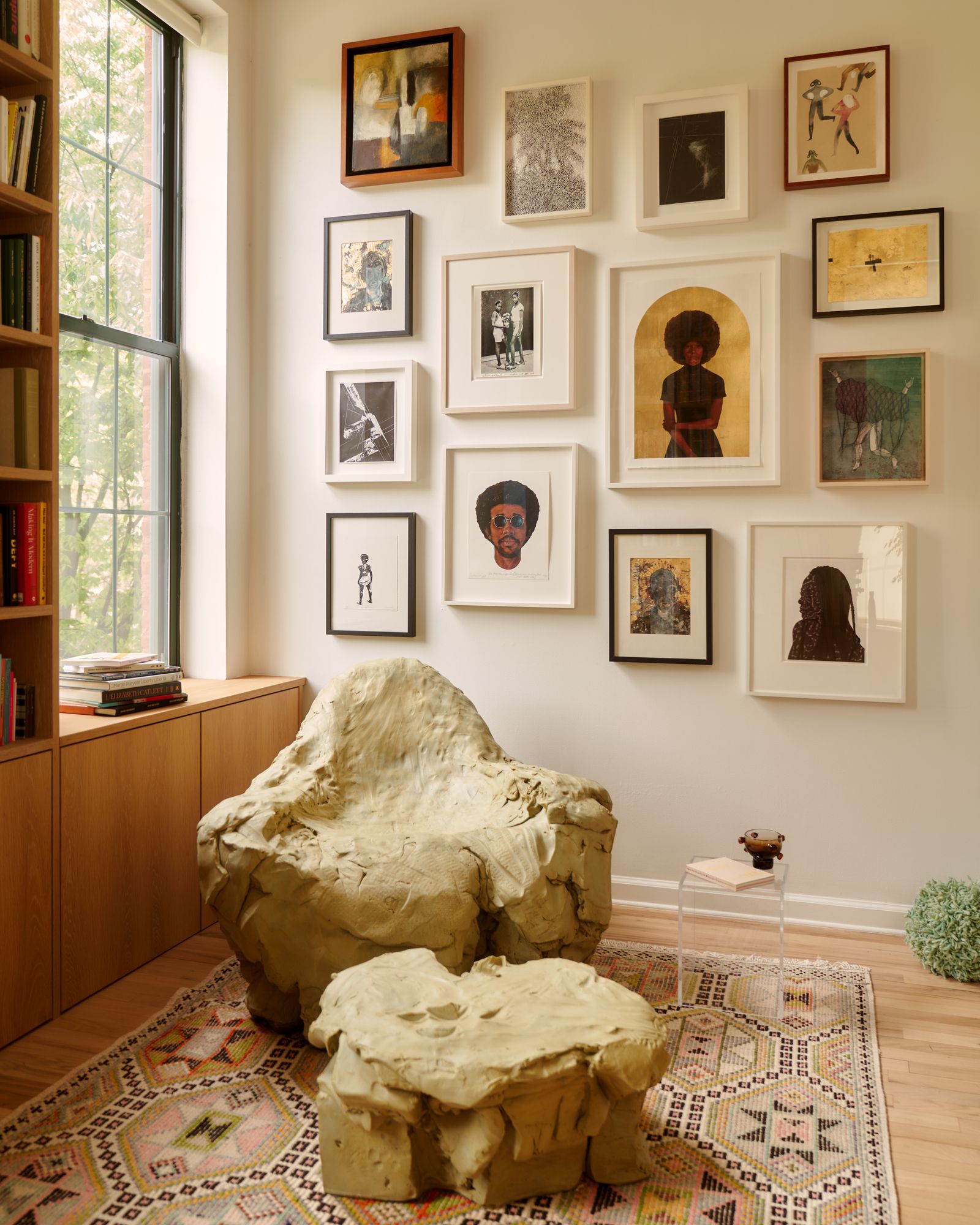
A gallerist’s Clinton Hill apartment reveals how painting, sculptural furniture, family history and unorthodox choices can make a home feel genuinely collected.
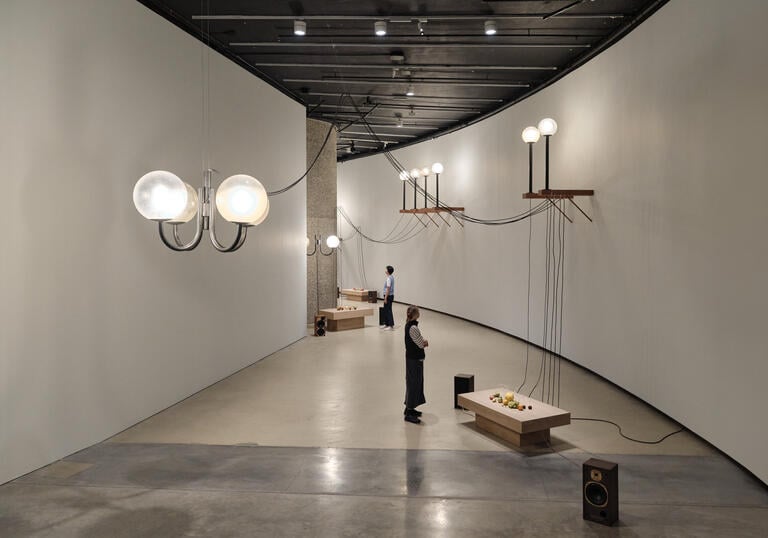
With light, sound, fruit and kinetic systems, Yuko Mohri makes the Barbican’s Curve into an argument for attending to what does not quite work as expected.