
October 24, 2026
Exhibitions
Exhibitions
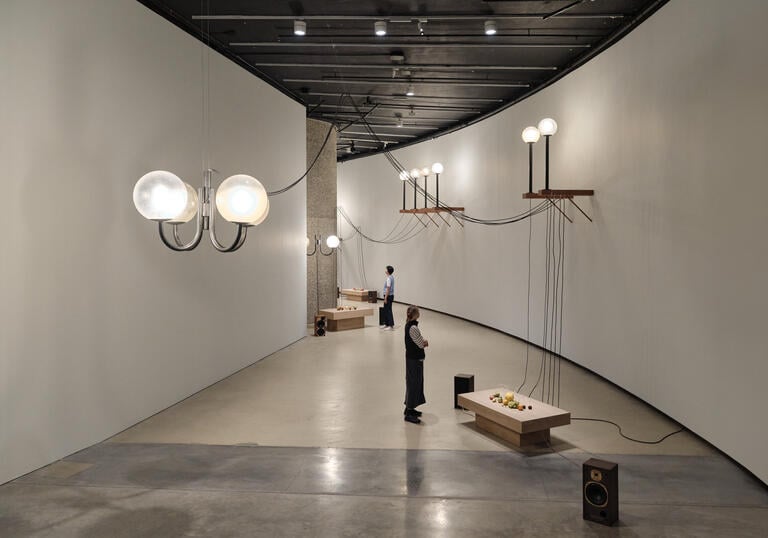
With light, sound, fruit and kinetic systems, Yuko Mohri makes the Barbican’s Curve into an argument for attending to what does not quite work as expected.
Three months after opening week, Koyo Kouoh’s In Minor Keys is easier to hear. A reassessment of the 2026 Venice Biennale asks whether slow looking can survive inside the world’s loudest art event.
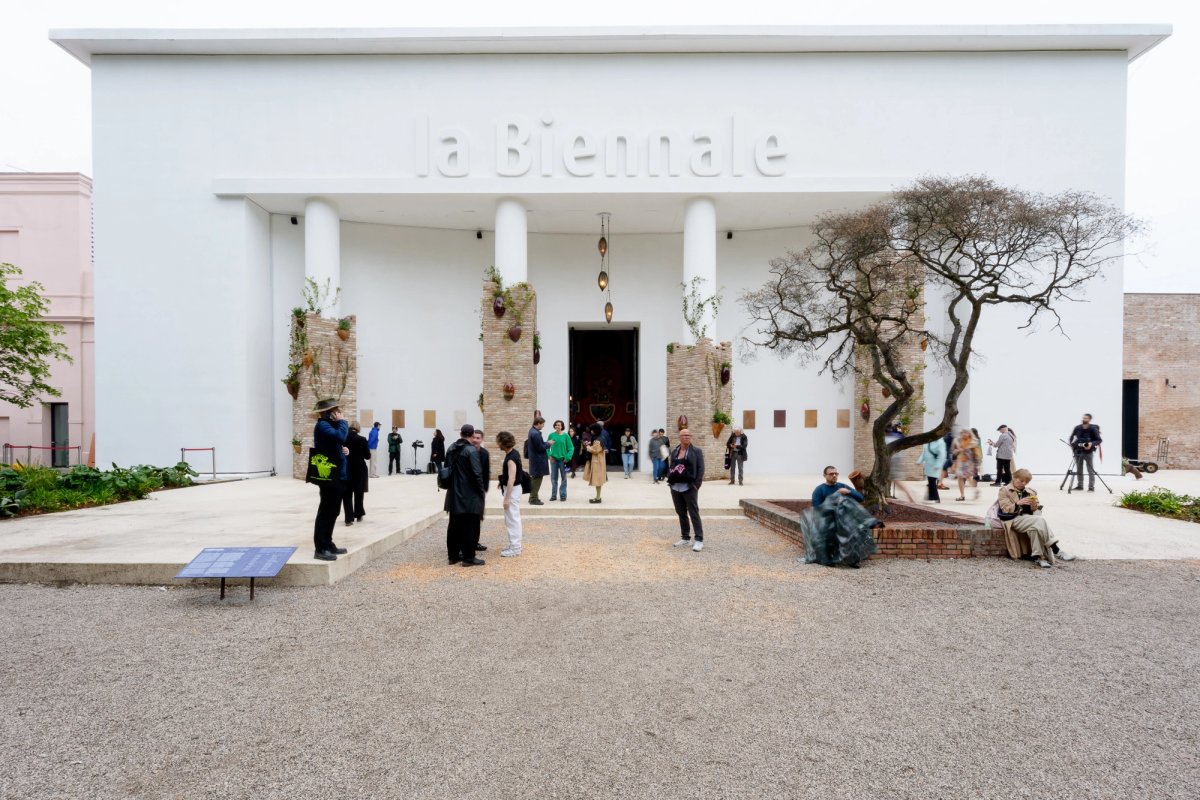
Three months after Venice’s opening-week rush, Koyo Kouoh’s In Minor Keys can finally be approached on the terms it asks of us: slowly. What emerges is not a Biennale that needs to be conquered, but one that becomes more coherent when the instinct to complete it is abandoned.
The Venice Biennale is almost structurally hostile to slow looking. Opening week turns art into logistics: boats, invitations, queues, national pavilions, dinners, announcements and the private anxiety that somebody else has already seen the thing you have not. By the time a visitor reaches the main exhibition, the eye is often operating like a scanner. That is precisely the mode Koyo Kouoh’s In Minor Keys asks us to resist.
Kouoh’s curatorial text begins by asking the reader to breathe, drop the shoulders and move into a slower gear. It is not wellness language pasted onto an exhibition. It is a challenge to the habitual tempo of the international art world. The 61st International Art Exhibition runs from 9 May to 22 November 2026 across the Giardini, the Arsenale and additional sites. It brings together 110 invited participants, alongside 100 national presentations. The scale is enormous. Yet its proposed unit of attention is intimate: listening, resting, returning, noticing affinities rather than collecting highlights.
That contradiction—between the size of Venice and the quietness of Kouoh’s proposition—was always going to be the exhibition’s central difficulty. It also makes a late-summer revisit more revealing than an opening-week verdict.
Kouoh died unexpectedly in May 2025, almost exactly a year before the Biennale opened. The circumstances make any assessment unusually delicate, but they should not make criticism impossible. By the time of her death, La Biennale says she had established the theoretical framework, chosen the artists and works, selected catalogue authors, set the graphic identity and exhibition architecture, and begun sustained dialogue with participants. The exhibition was then realised by the team she had selected: Gabe Beckhurst Feijoo, Marie Hélène Pereira, Rasha Salti, Siddhartha Mitter and Rory Tsapayi, with the support of Kouoh’s family.
The result should therefore be understood neither as a speculative reconstruction nor as an exhibition frozen at the moment of her death. It is closer to a score whose composer had established the key, players, motifs and structure, but could not be present for every decision in performance. That distinction helps explain both the show’s extraordinary coherence in places and its instability in others.
The title itself is deliberately capacious. A minor key is musical structure and emotional register, but Kouoh also allowed it to expand toward low frequencies, improvisation, consolation and the quieter forms of persistence that survive under pressure. Her team developed motifs including shrines, procession, schools and rest. Wolff Architects used indigo textile thresholds in the Central Pavilion and Arsenale to signal transitions between constellations of work rather than imposing a rigid chronology.
The most persuasive way to experience In Minor Keys is to stop asking whether you have seen enough of it.
Opening-week reviews repeatedly identified the Central Pavilion as the less resolved half of the exhibition. The criticism is fair. Some rooms are densely polyphonic; works return across different spaces; quieter practices can be crowded by more declarative neighbours. Ben Luke, writing in The Art Newspaper, admired the works more than the exhibition’s pacing and argued that the Arsenale offered the stronger dramaturgy. Frieze likewise found a tension between Kouoh’s relational intentions and the inherited machinery of the Biennale.
But distance from opening week alters the diagnosis. What first reads as a failure of hierarchy can also be approached as a refusal of the standard blockbuster contract. Biennials usually train us to seek the masterpiece, the room everyone photographs, the artist whose market is about to move. In Minor Keys repeatedly interrupts that behaviour. Artists resurface. Practices touch and separate. A plant, a text, a textile or a sound can function as connective tissue rather than as a self-contained event.
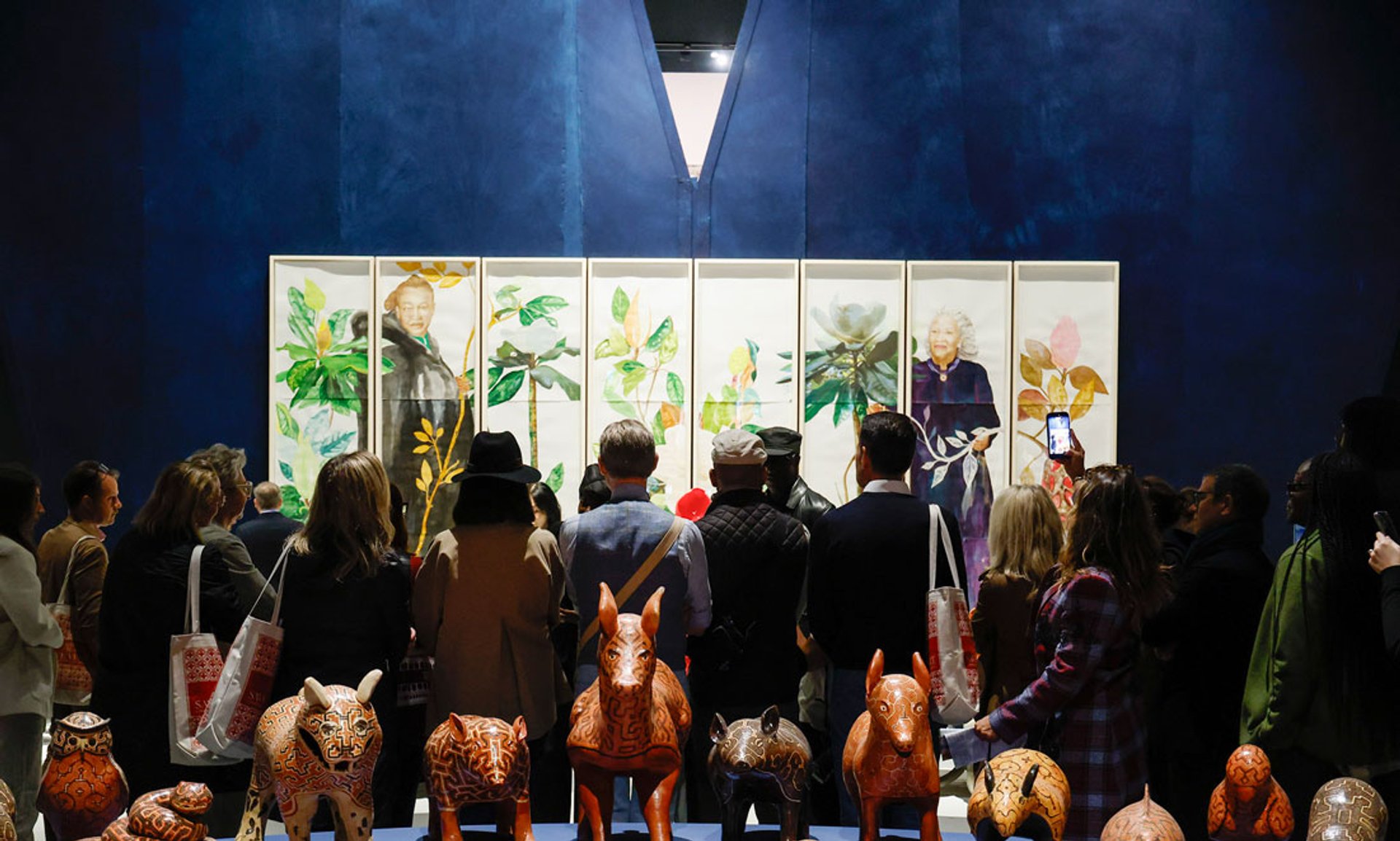
Maria Magdalena Campos-Pons makes that relational logic especially legible. Her images of Kouoh and Toni Morrison do not operate simply as portraits or memorials. They place intellectual and curatorial lineage inside a larger ecology of magnolias, hybrid bodies and transformed identities. Nearby, Otobong Nkanga’s intervention on the Central Pavilion columns allows vegetation, brick, terraria and bee habitats to disturb the supposed purity of modernist architecture. The garden becomes not decoration but a way of thinking about persistence and occupation.
This is where the exhibition begins to reward revisiting. On a first pass, the eye registers objects. On a second, relationships emerge: between the cultivated and the fugitive, between memorial and regeneration, between the human body and plant form, between the archive and the things that resist being filed neatly inside it.
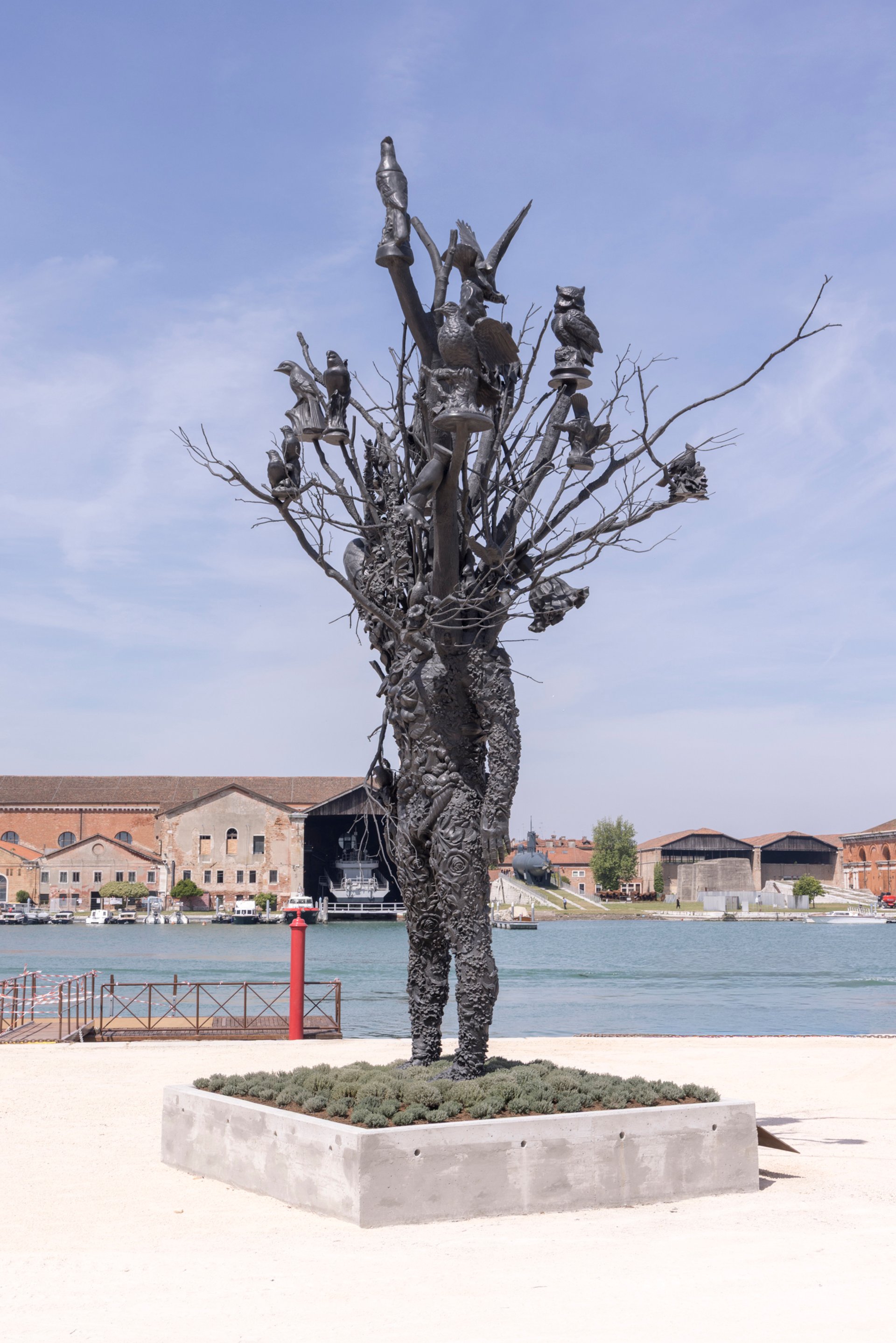
The Arsenale provides the exhibition more room to breathe. Its long sequence naturally produces procession, and the increased physical separation allows works to establish their own atmospheres before being folded back into the larger score. Nick Cave’s Amalgam (Origin), positioned toward the harbour, transforms the body into a tree supporting a migration of birds. The work is monumental without feeling triumphalist. Its scale produces shelter as much as authority.
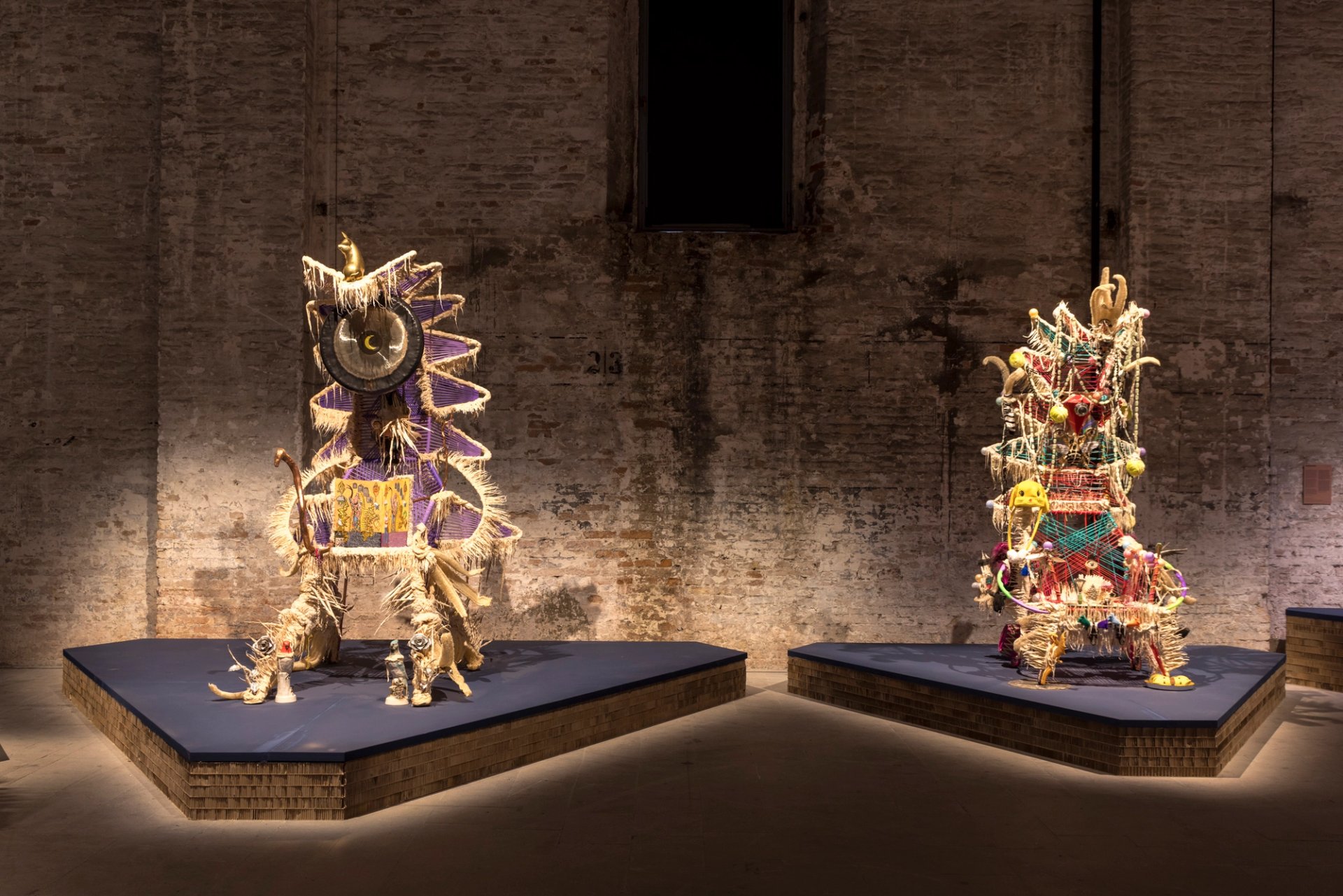
Elsewhere, Guadalupe Maravilla’s ICE Age Disease Thrower sculptures turn biographical displacement, healing practices, woven furniture, talismanic objects and bodily memory into structures that seem simultaneously protective and unstable. The objects do not illustrate migration in a documentary sense. They carry it materially: journeys and systems of survival have become part of their construction.
The strength of these passages is that Kouoh’s optimism never requires innocence. Beauty is not offered as an escape from violence. It is treated as one of the forms by which people continue after violence. That distinction keeps In Minor Keys from becoming a generalised exhibition about care—a category now so common in contemporary curating that it can lose specificity. Here, care is often accompanied by exhaustion, history, repair and unresolved grief.
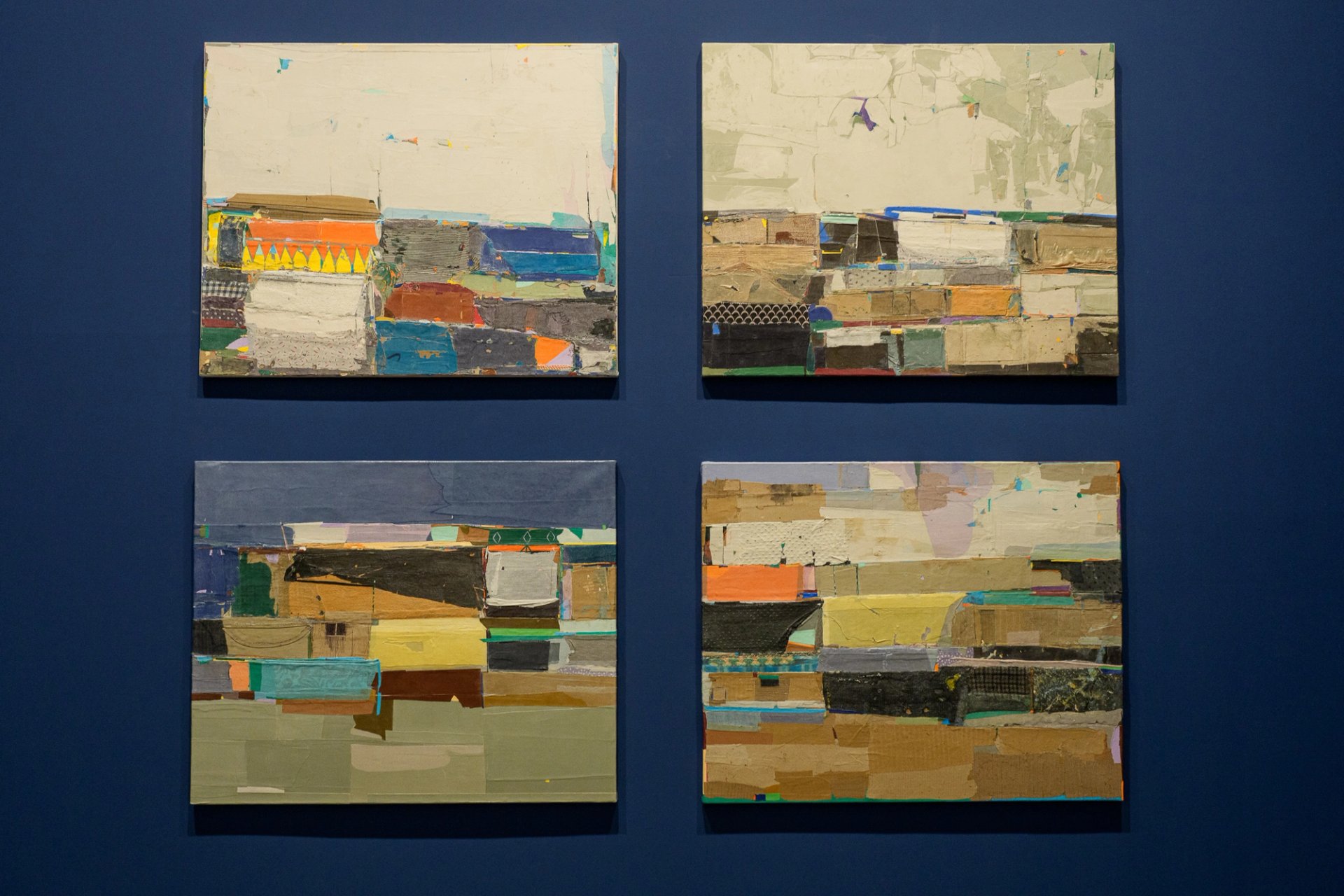
Mohammed Joha provides a useful test. His tender collages, made from modest fragments of paper and fabric and rooted in the architecture and environment of Gaza, are dispersed rather than granted the ceremonial emphasis of a single room. One can reasonably argue that this weakens them. Yet their recurrence also changes the visitor’s relationship to recognition. The work is encountered, lost and encountered again.
That pattern suggests a different way to navigate the Biennale. Instead of treating Venice as an enormous checklist, choose several practices and follow their echoes. Sit in the spaces designed for rest. Return from the Central Pavilion to the Arsenale—or the reverse—on another day if possible. Let the exhibition remain incomplete. The instruction sounds obvious, but the art world has spent decades building events that reward exactly the opposite behaviour.
This is also why the exhibition’s abundance should not be romanticised. There are moments when polyphony becomes noise. Some juxtapositions feel more dutiful than electric. Sensory works can compete with one another, and the promise of lower frequencies is occasionally overwhelmed by installations that insist on immediate attention. A show about the politics of listening still has to decide when to turn the volume down.
Yet those weaknesses do not cancel the proposition. They expose how difficult it is to stage one. A Biennale that genuinely privileged rest, incompleteness and intimacy would have to work against its own tourism, architecture, nationalism, sponsorship and opening-week economy. In Minor Keys cannot escape that machine. It does, however, make the friction visible.
The opening itself was anything but minor. La Biennale reported roughly 10,000 public visitors on the first day, up about 10 percent on 2024, following 27,935 attendees during the professional preview period and 3,733 journalists. Immediate judgment was inevitable. By June, later responses were already more varied, with curators and artists describing the show less as a set of winners and more as an invitation to change bodily and intellectual position.
That later mode of attention is closer to the exhibition’s value. The important question is no longer whether In Minor Keys delivered a perfectly resolved statement in May. It did not. The more interesting question is whether its organising ideas continue to generate ways of looking after the event’s publicity has cooled. On that measure, the exhibition grows.
It is also important that this growth does not become hagiography. Kouoh’s death should not convert every curatorial decision into something beyond debate. Respecting the seriousness of her project means allowing it to be tested. The show is uneven. Its dispersal sometimes obscures artists it intends to foreground. The Central Pavilion can work against the rest it promises. But the exhibition’s best passages remain unusually resistant to the art world’s demand for instant legibility.
Look beyond the headline works: the exhibition is particularly useful for identifying practices that deepen through repeated encounter rather than immediate visual impact.
Follow exhibition histories: many participants have significant institutional trajectories outside Venice; treat the Biennale as a research node, not a market endorsement.
Compare media: textiles, sound, moving image, archives and organic material are central to the show. For acquisition, the conservation and installation implications are part of the work, not secondary administration.
Do not confuse inclusion with availability: participation in a Biennale can increase visibility without making important works easier to acquire.
The best achievement of In Minor Keys may therefore be methodological rather than thematic. It asks the visitor to abandon the fantasy of mastery: to accept that a vast exhibition can be approached through fragments, returns and affinities instead of completion.
Venice rarely encourages that humility. Three months after the opening-week noise, it may finally be possible to hear it.
With light, sound, fruit and kinetic systems, Yuko Mohri makes the Barbican’s Curve into an argument for attending to what does not quite work as expected.

A new contemporary art centre has opened on Renault’s historic Île Seguin site. Cecilia Alemani’s Moteur Imaginaire turns the factory, car and machine into a century-spanning argument about modern life.
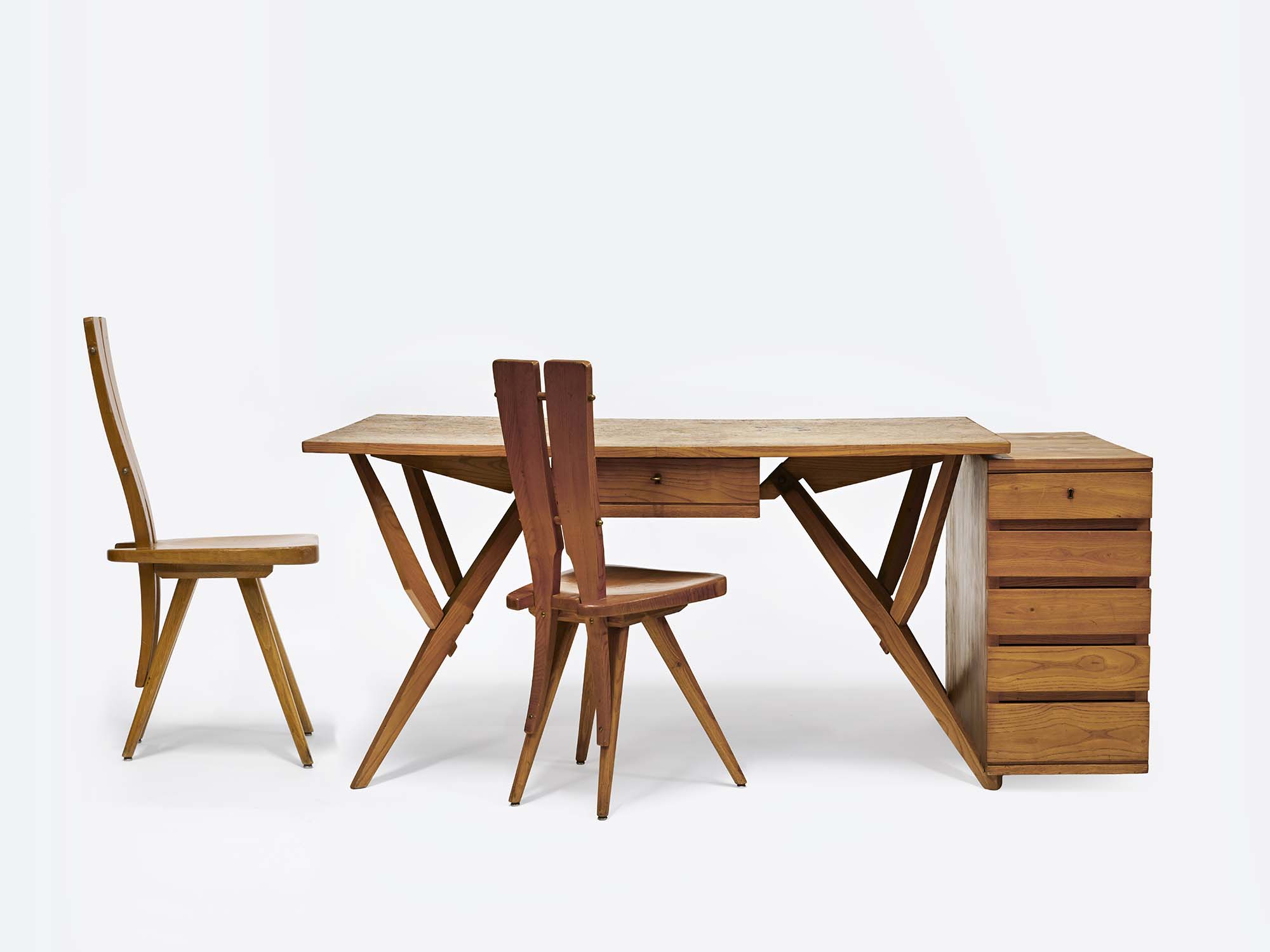
From Carlo Mollino and Faye Toogood to Misha Kahn and Gallery FUMI, PAD London 2026 showed what discerning art collectors can learn from sculptural furniture and material experimentation.