
October 10, 2026
Exhibitions
Exhibitions
From Robert Ryman and Lorna Simpson to Mary Ramsden, Martine Syms and Nicola Turner, the strongest London route during Frieze week begins outside the fair.
From the Polder Sofa to Frog Table and 300 coloured vases, Hella Jongerius has spent three decades proving that industrial design can retain craft, variation and material intelligence.
Hella Jongerius has spent more than three decades arguing against the fantasy that good design should erase the evidence of how it was made. Seams can remain visible. Glazes can vary. Colour can refuse standardisation. A mass-produced sofa can contain deliberate irregularities, and industrial collaboration can become a site of negotiation rather than a surrender to uniformity.
The Vitra Design Museum’s Whispering Things, the first major comprehensive retrospective of Jongerius’s career, closed in Weil am Rhein on 6 September after bringing together more than 400 works, prototypes, sketches and archival documents. The exhibition travels to the Museum für Kunst und Gewerbe Hamburg on 16 October. That transition makes this a useful moment to consider Jongerius not simply as the designer of recognisable furniture and textiles, but as one of the figures who changed the terms on which contemporary design could be collected.
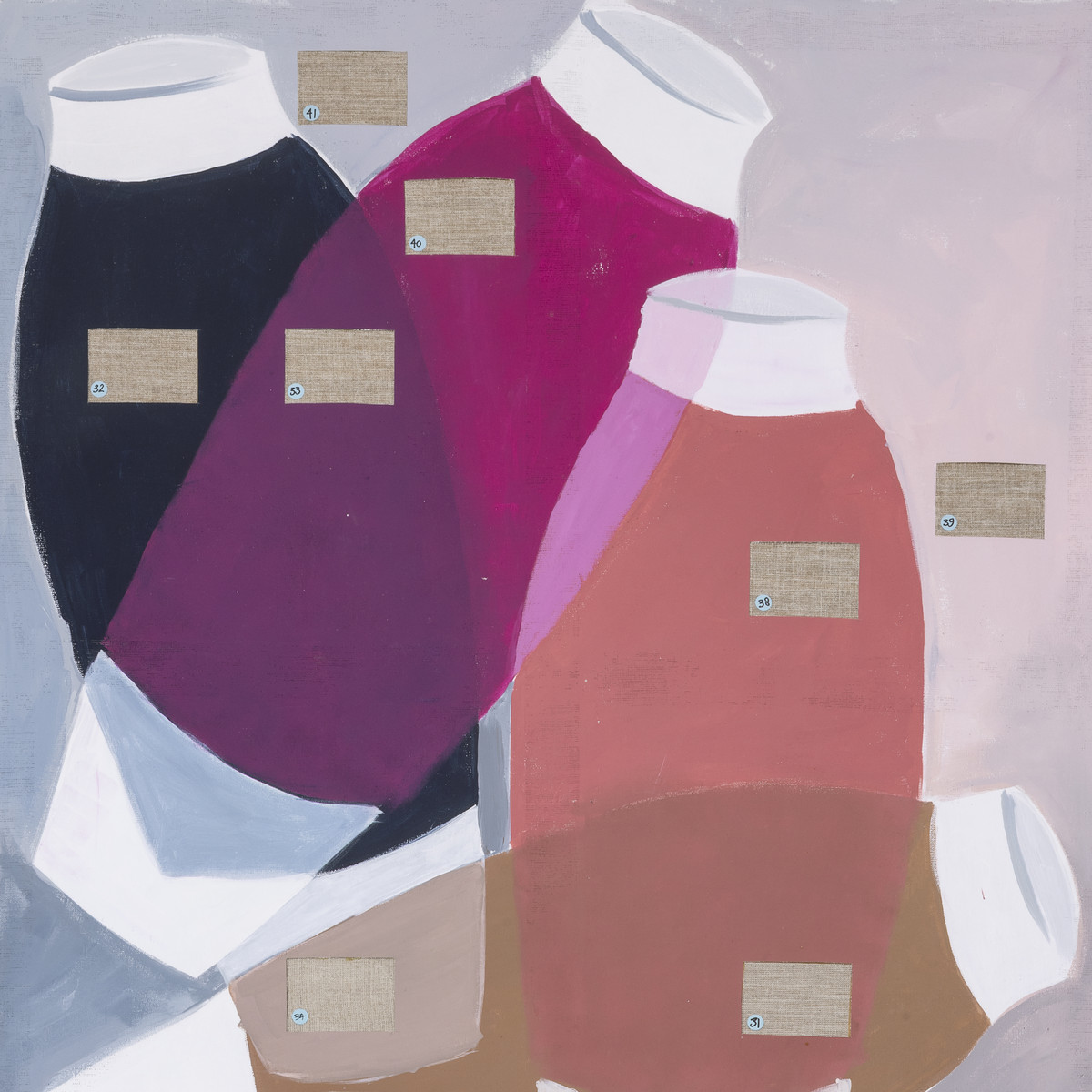
Key visual for Hella Jongerius: Whispering Things. © Vitra Design Museum. Graphic design: Joost Grootens, based on Hella Jongerius’s Falling Vases Paintings.
Jongerius emerged through Dutch design in the 1990s, including the orbit of Droog, at a moment when designers were challenging the idea that industrial objects had to present themselves as seamless, neutral products. Her work carried that argument into larger commercial systems without giving up the handmade trace.
This is easy to misunderstand as an aesthetic preference for charming imperfection. The deeper issue is informational. A visible stitch tells you how a textile was constructed. Uneven glaze records the chemistry of firing. A repair reveals that an object has a history rather than a permanently new condition. For Jongerius, those traces allow things to communicate their origins.
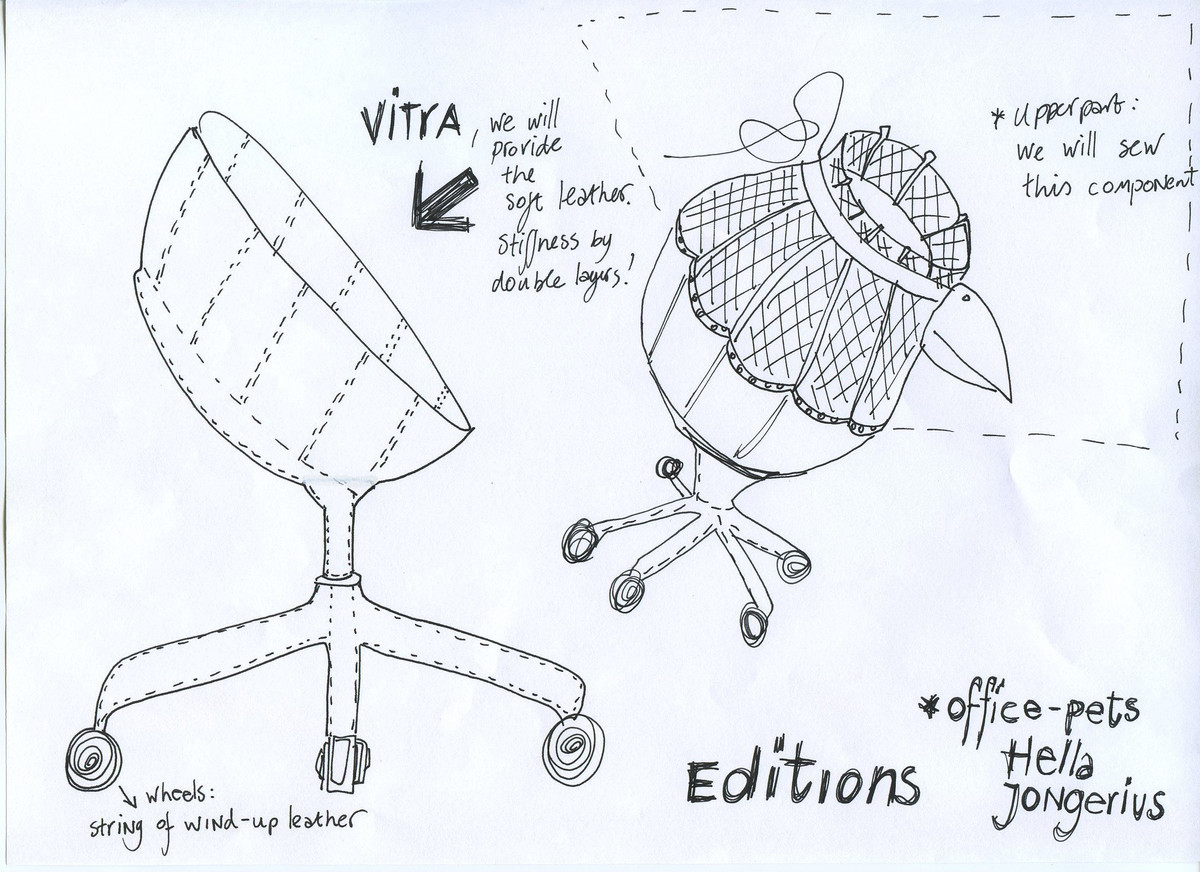
Hella Jongerius, Office Pets, sketch for Vitra, 2007. © Jongeriuslab. Image courtesy Vitra Design Museum.
The retrospective’s first section, Dirty Hands, made that philosophy literal by foregrounding physical making. Ceramics, textiles and furniture appeared alongside documentation of hands at work. The point was not nostalgia for pre-industrial craft. It was to insist that technical systems are richer when designers understand material behaviour rather than treating production as an invisible service.
Jongerius’s career is unusually important because her critical position survived contact with major companies. She has worked with Vitra, Maharam, KLM, Camper, IKEA, Nike and others, often inside systems where consistency and efficiency are fundamental commercial demands.
The retrospective’s Business Class section did not present these collaborations as polished corporate triumphs. It showed sketches, prototypes, material tests and correspondence—the evidence of negotiation. This is where her practice becomes especially relevant to collectors of design. Authorship is not always visible as a handmade signature. It can exist in the decisions that shape colour ranges, textiles, seating systems and the way industrial tolerances are allowed to vary.
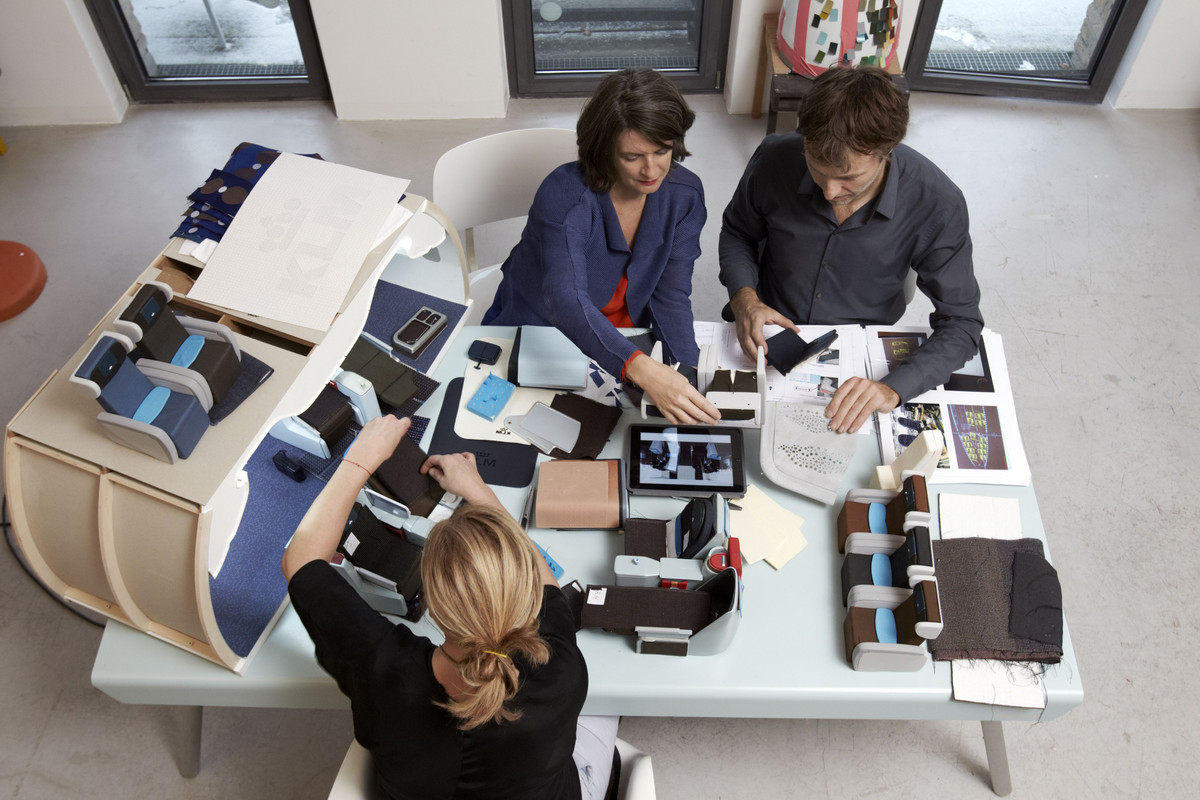
Hella Jongerius and collaborators during the KLM World Business Class cabin-interior design process, 2011. © Jongeriuslab. Photo: Marcus Gaab. Image courtesy Vitra Design Museum.
For ARTCOLLECTORHOMES, this is an important distinction. A collectible object does not become artistically serious merely because it was made in a tiny edition. Mass production and authorship are not opposites. The relevant question is whether a designer has transformed the industrial system rather than simply styled its output.
Jongerius’s research into colour is one of the clearest examples of this method. She has repeatedly rejected the idea that colour can be understood as a fixed digital or commercial specification. The same pigment changes under different light, beside different materials and at different scales.
The retrospective’s Feeling Eye section gathered colour studies, woven experiments, paper constructions and a monumental installation of roughly 300 Coloured Vases. The vases work almost like a three-dimensional colour chart, but one in which variation is the point rather than an error to be corrected.
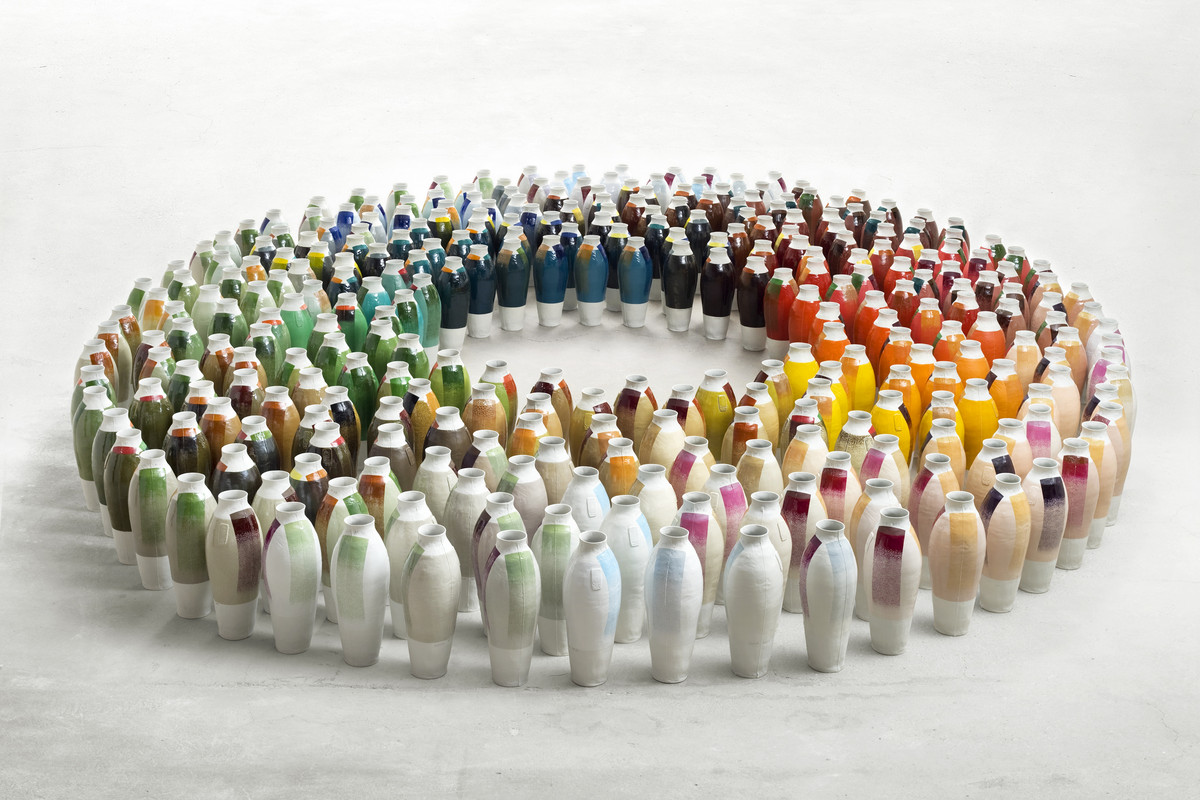
Hella Jongerius, Coloured Vases, Series 3, 2010. © Jongeriuslab. Photo: Gerrit Schreurs. Image courtesy Vitra Design Museum.
For collectors and interior designers, this research has a practical consequence. Colour should be judged in the room, not only from a sample or screen. A textile beside stone, timber or a painting will change. Daylight will move across it. The object participates in an environment rather than arriving with a self-contained colour identity.
Jongerius’s recent work pushes the practice further toward sculpture. Animals have appeared throughout her career, sometimes humorously and sometimes as unsettling surrogates for human behaviour. The Frog Table is particularly revealing: a recognisable piece of furniture appears to have been invaded by an animal form that is neither decoration nor removable ornament.
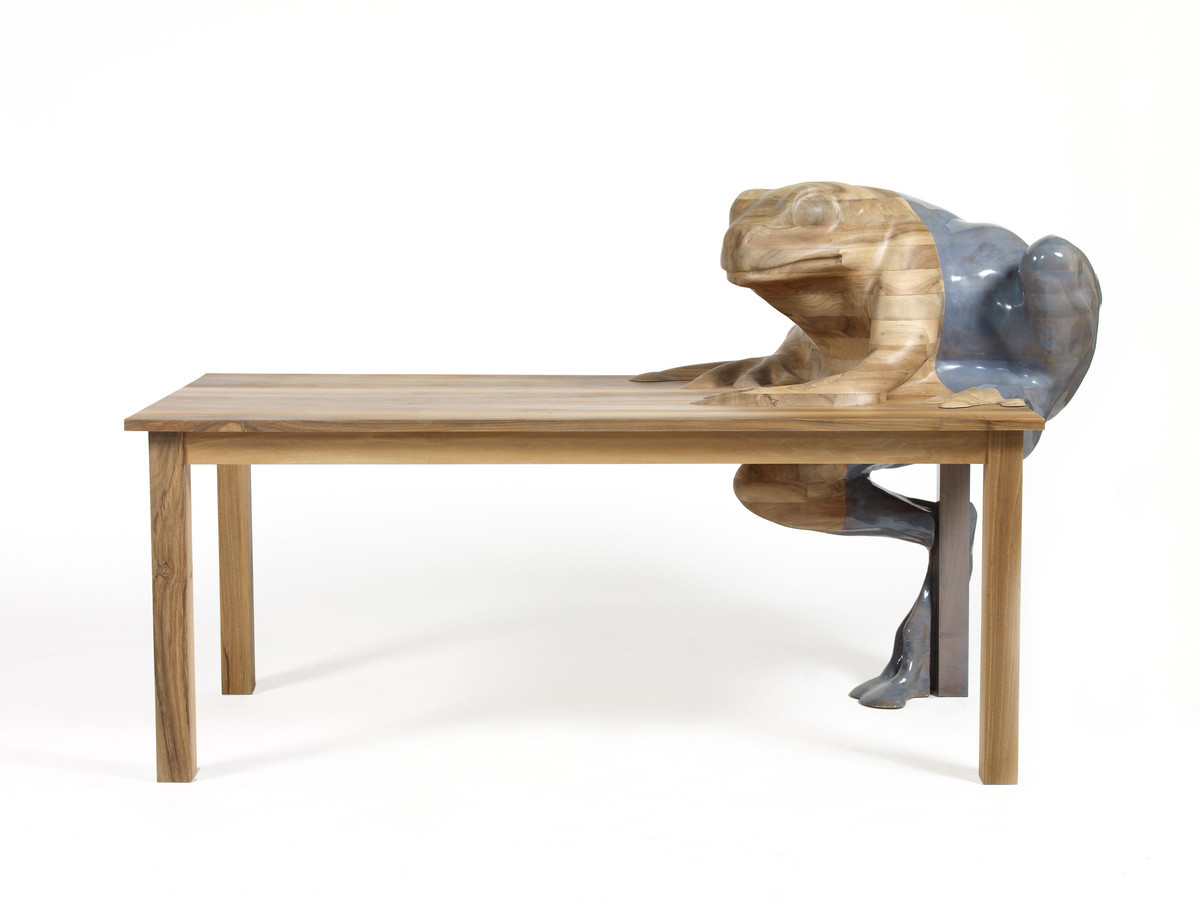
Hella Jongerius, Frog Table, 2007. © Galerie kreo. Photo: Fabrice Gousset. Image courtesy Vitra Design Museum.
The retrospective’s final section, Cosmic Mind, brought these ideas into a broader consideration of nonhuman agency, coexistence and the emotional lives we project onto objects. Angry Animals, Space Amulets and kinetic textile works suggest that design need not stop at solving human convenience.
This is also where the boundary between design and art becomes least useful. The Frog Table still has a tabletop, but its sculptural presence changes how one understands its function. It is not simply furniture with an artistic flourish. The artistic proposition and the functional object have become the same thing.
Jongerius’s long relationship with industry means that her output spans very different collecting categories: serially produced furniture, limited projects, prototypes, unique ceramic works, textile research, sketches and autonomous sculpture. Those categories should not be collapsed.
A Vitra production piece may be significant because of its place in design history and its ability to be lived with extensively. A prototype or experimental ceramic may carry rarity and direct evidence of process. A sketch can reveal the conceptual origin of a celebrated project. Collectors should document manufacturer, production date, edition or prototype status, materials, provenance and whether an object belongs to a known development sequence.
Condition should also be read intelligently. Jongerius’s work often values material irregularity, visible seams and variation. Restoration that attempts to make an object look uniformly “perfect” can erase precisely the qualities the designer intended.
The most urgent question in Whispering Things is also the simplest: what does it mean to design more objects in a world that already has enough? Jongerius does not answer by withdrawing from production entirely. She argues instead for greater attention—to material, durability, repair, colour, labour and the possibility that objects might deserve care rather than rapid replacement.
That makes her especially relevant to the culture of collecting now. The strongest homes are not improved by accumulating more objects indiscriminately. They are improved by selecting things capable of deepening through use: furniture whose materials age intelligently, textiles whose colour changes with a room, ceramics that retain the trace of a hand, and objects whose design remains interesting after novelty has disappeared.
Jongerius has spent thirty years making imperfection compatible with industrial sophistication. That may be her most important contribution: not convincing industry to imitate craft, but proving that mass production does not have to silence the material intelligence of things.
Hella Jongerius: Whispering Things
Vitra Design Museum, Weil am Rhein: 14 March–6 September 2026.
Travels to Museum für Kunst und Gewerbe Hamburg: 16 October 2026–30 May 2027.
From Robert Ryman and Lorna Simpson to Mary Ramsden, Martine Syms and Nicola Turner, the strongest London route during Frieze week begins outside the fair.
From the Polder Sofa to Frog Table and 300 coloured vases, Hella Jongerius has spent three decades proving that industrial design can retain craft, variation and material intelligence.
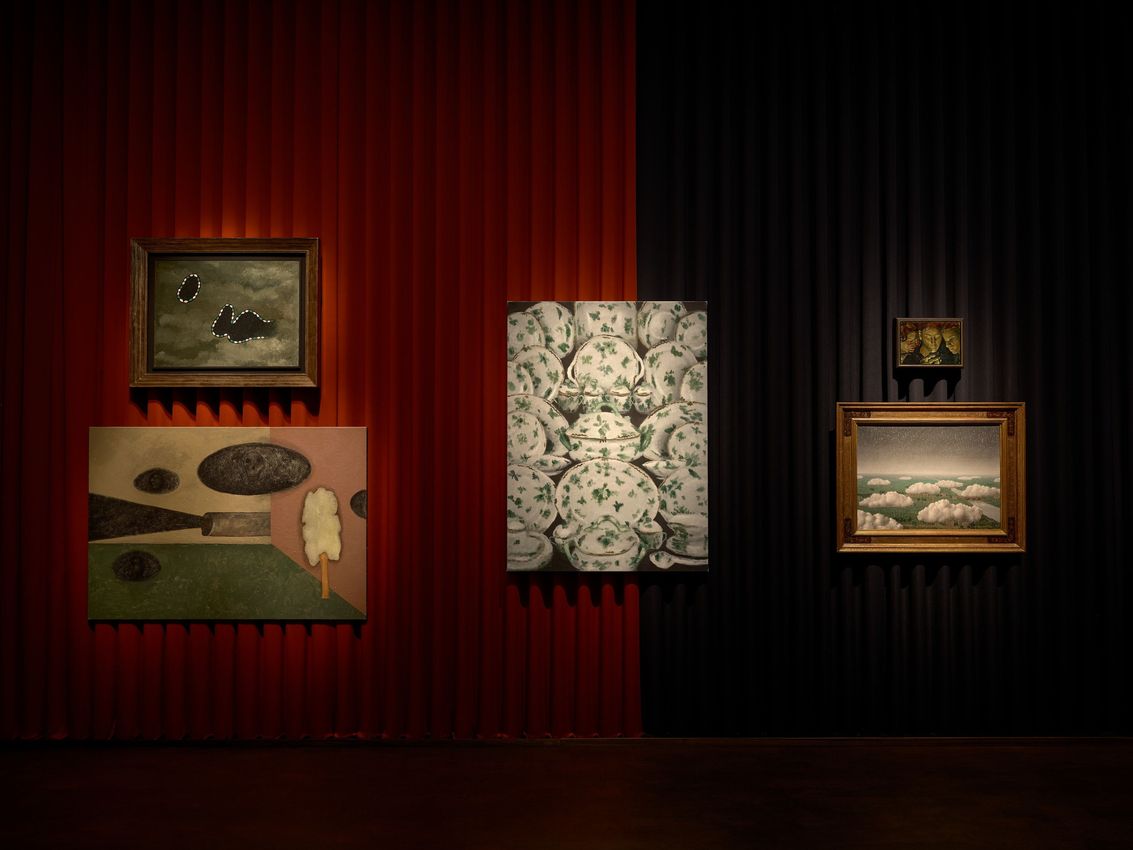
Gagosian’s ambitious London exhibition places René Magritte beside more than forty artists. For collectors, its real value lies in separating meaningful artistic inheritance from superficial resemblance — and in seeing why Magritte’s central problem, the unstable relationship between image and reality, feels newly urgent.