
October 11, 2026
Exhibitions
Exhibitions
In her first UK institutional exhibition, Evelyn Taocheng Wang turns mistranslation, Agnes Martin, Chinese literati painting and fantasies of Britain into a deliberately unstable language of identity.
In her first UK institutional exhibition, Evelyn Taocheng Wang turns mistranslation, Agnes Martin, Chinese literati painting and fantasies of Britain into a deliberately unstable language of identity.
Evelyn Taocheng Wang has made mistranslation one of the most productive tools in contemporary painting. A Chinese ink painting is called a “drawing” by someone unfamiliar with its history; Xuan paper becomes “rice paper”; an artist moving between cultural systems discovers that categories presented as neutral are often simply local habits pretending to be universal. Wang’s response has never been to correct every error. She has learned how to use the errors.
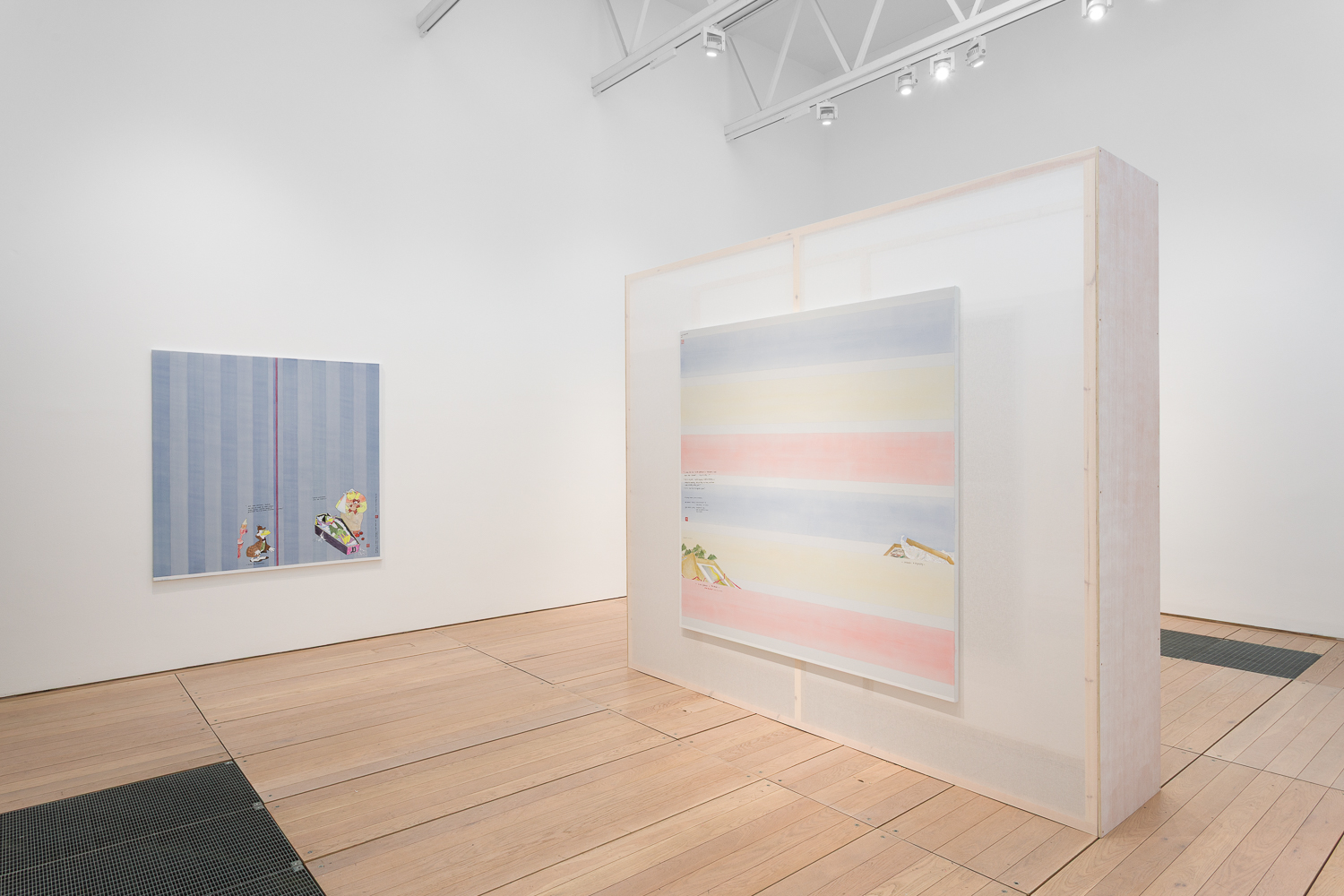
Being Poetic Ruins Life, her first institutional exhibition in the United Kingdom, opened at Goldsmiths CCA on 25 September and brings together existing and newly commissioned work across painting, textile, installation and video. The exhibition occupies the building as a deliberately unstable cultural interior: Agnes Martin can meet Chinese literati painting; Virginia Woolf can share space with Count Duckula; Merchant Ivory can coexist with Eileen Chang; British nostalgia is filtered through the perspective of a Chinese-born artist who has spent much of her adult life in Europe.
Installation view, Evelyn Taocheng Wang: Being Poetic Ruins Life, Goldsmiths CCA, London, 2026. Photo: Rob Harris. Courtesy Goldsmiths CCA.
The exhibition’s title refers to the historical discipline expected of privileged male scholar-artists in China, for whom artistic cultivation could require withdrawal from ordinary life. Wang takes that inherited ideal and asks a blunt contemporary question: who has historically been granted the right to become “poetic”, and whose labour, gender or social position made that withdrawal possible?
Her answer is not a new purified identity. Instead, she proposes a deliberately compromised figure she has called the “Cultural Whore”: an artist who steals, imitates, desires, misreads and recombines cultural material without pretending that any single tradition can provide an uncontaminated home.
That position is central to understanding Wang. She is not simply combining East and West as two stable blocks. She is interested in the fact that neither side remains stable once images, people and language begin to travel.
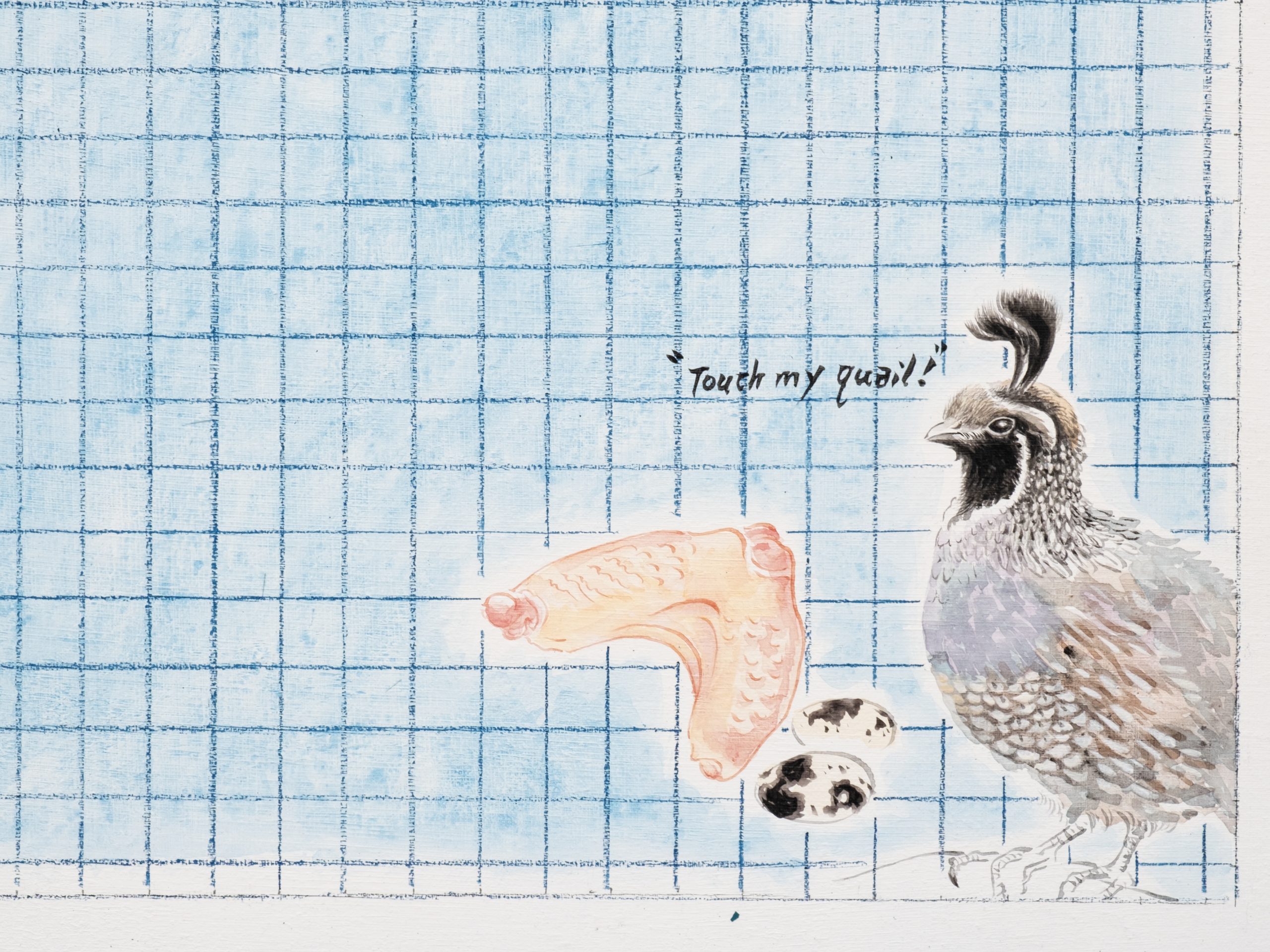
Evelyn Taocheng Wang, detail from Mr Darcey Jumping into My Darcey’s Lake, 2026. © Evelyn Taocheng Wang. Courtesy the artist, Antenna Space, Shanghai, and Carlos/Ishikawa, London. Photo: Stephen James.
Agnes Martin has become one of Wang’s most persistent art-historical interlocutors. At first glance, the connection seems improbable. Martin’s gridded abstractions are often discussed through stillness, transcendence and the rhetoric of universal feeling. Wang copies aspects of that visual language and then interrupts it with calligraphic text, seals and meticulous motifs drawn from gongbi painting, literary history and popular culture.
The intervention is more serious than parody. Modernist abstraction often presented itself as if it could transcend cultural specificity. Wang asks what happens when that claim is viewed by someone trained in another highly codified system of painting and writing. The grid stops being universal and becomes one historical language among others.
Installation view, Being Poetic Ruins Life, Goldsmiths CCA, London, 2026. Photo: Rob Harris. Courtesy Goldsmiths CCA.
For collectors, this matters because Wang’s references can be easy to flatten into visual quotation. The stronger works are not interesting because one can identify Martin, literati painting or British popular culture. They are interesting because the collision changes the meaning of each source.
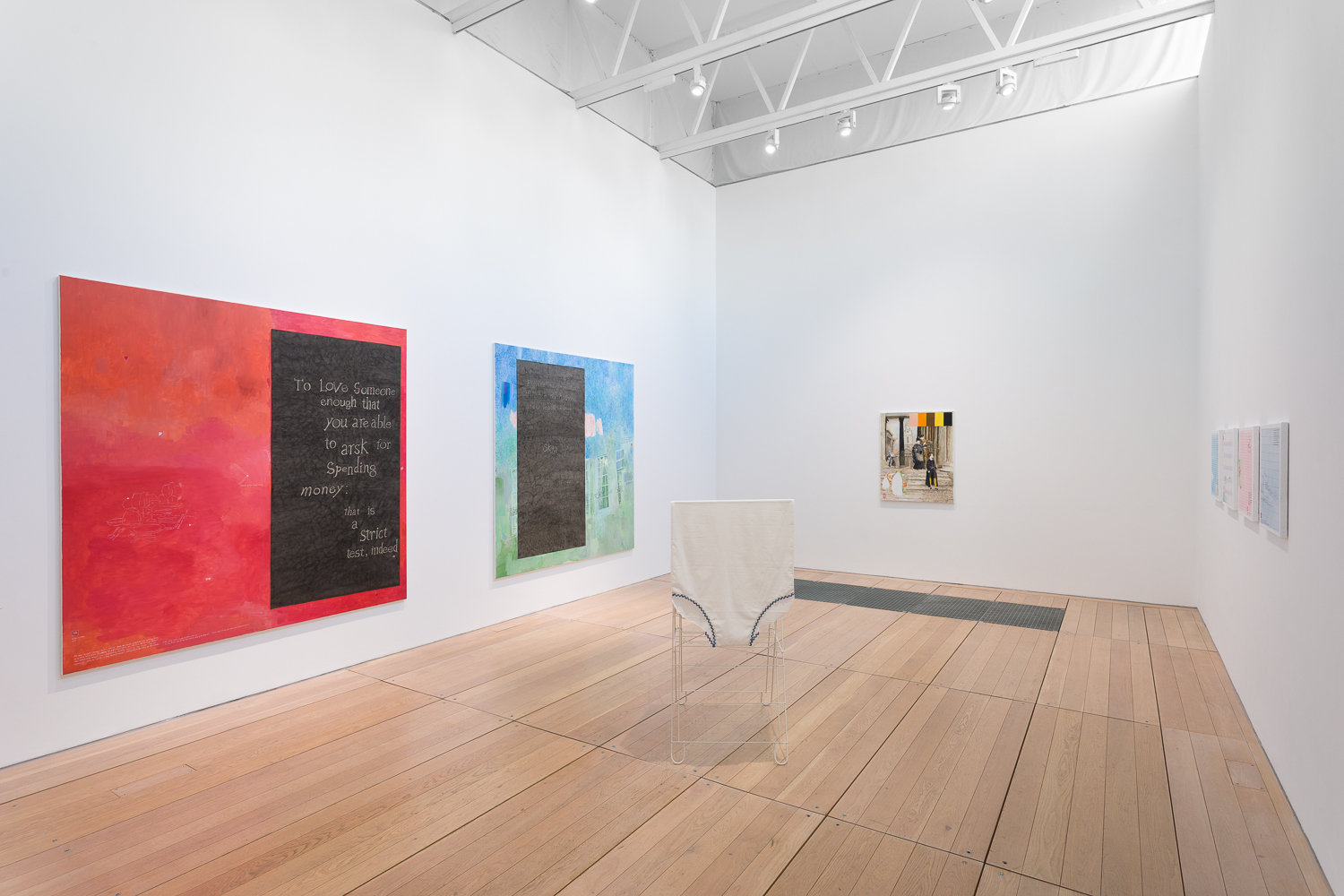
Wang’s new commissions also turn toward Britain itself: Jane Austen adaptations, Merchant Ivory films, James Bond, Virginia Woolf and other fragments of a culture that circulates internationally through images long before anyone encounters the country directly.
That makes the exhibition a study of Britain as projection. Wang is less interested in representing the nation accurately than in exposing the process through which cultural fantasies are assembled. Imported television, films, translated novels, fashion and art books created one Britain; migration, class systems and lived experience create another. The gap between them is precisely where her work operates.

Installation view, Evelyn Taocheng Wang: Being Poetic Ruins Life, Goldsmiths CCA, 2026. Photo: Rob Harris. Courtesy Goldsmiths CCA.
Wang’s biography makes the politics of medium unusually concrete. At Nanjing Normal University she studied Chinese classical literature, calligraphy and landscape painting alongside mathematics and English. After moving to Europe in 2008, she encountered viewers who treated ink on Xuan paper as a lesser “drawing” practice rather than painting. Her joking retaliation—calling Western oil paintings “potato” or “bread” paintings—exposed the arbitrariness of the hierarchy.
This is one reason her work moves so fluently between paper, silk, textile, video, painting and installation. Medium is never merely technical. It carries assumptions about prestige, nation, gender and artistic legitimacy.
Collectors should therefore resist trying to identify one “core” medium in the practice. A handscroll and a stretched canvas can be equally central if each activates a different history. Documentation of materials, mounting and display is especially important because some works depend on textile behaviour, hanging systems or installation relationships that should not be treated as optional framing decisions.
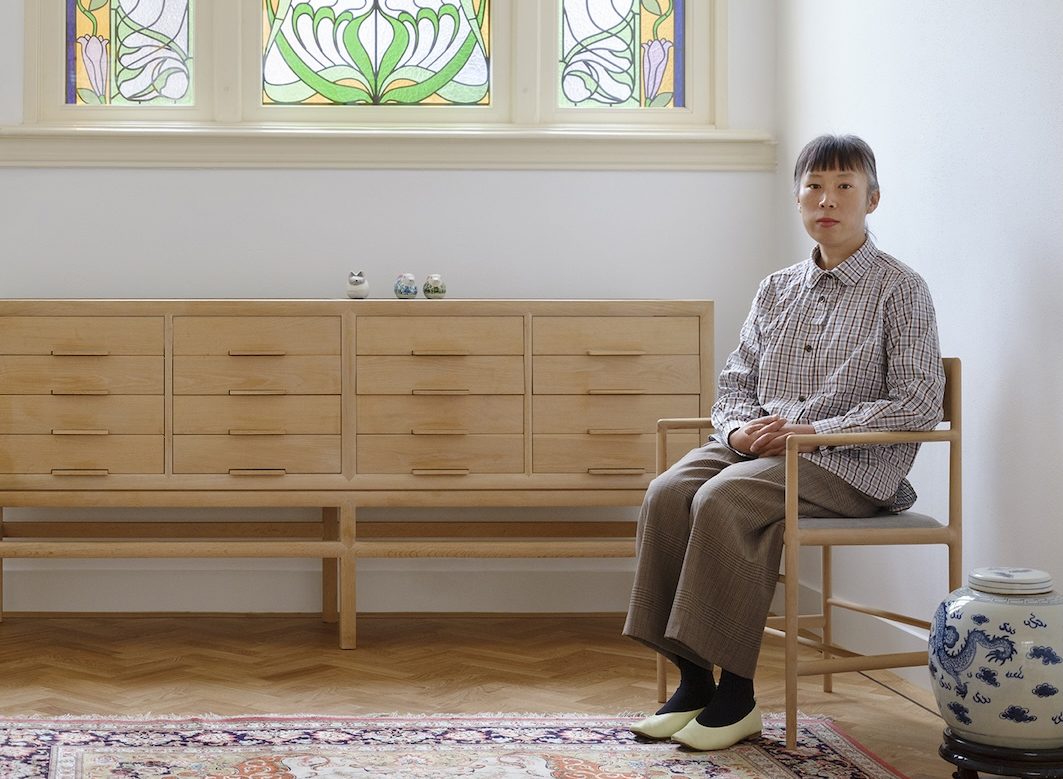
Evelyn Taocheng Wang, 2026. Photography by Cra; image published by Goldsmiths CCA for the artist’s October talk. Courtesy the artist, Antenna Space, Shanghai, Carlos/Ishikawa, London, and Goldsmiths CCA.
Wang’s work has entered major public collections including MoMA, the Art Institute of Chicago, Centre Pompidou, MASP and the National Museum of Art, Osaka, and she was included in the 2024 Venice Biennale curated by Adriano Pedrosa. Those institutional markers matter, but they should not encourage a neat retrospective reading of the practice.
Its strength lies in refusing neatness. Wang can be elegant and awkward, scholarly and camp, technically refined and deliberately incorrect. She understands that cultural identity is rarely experienced as a clean system. It is built from translation, fantasy, aspiration, error and borrowed forms.
Being Poetic Ruins Life makes that method visible at institutional scale. The exhibition is not an argument for one culture correcting another. It is an argument for the freedom created when no single culture is allowed the final word.
Evelyn Taocheng Wang: Being Poetic Ruins Life
Goldsmiths CCA, London
25 September–13 December 2026.
In her first UK institutional exhibition, Evelyn Taocheng Wang turns mistranslation, Agnes Martin, Chinese literati painting and fantasies of Britain into a deliberately unstable language of identity.
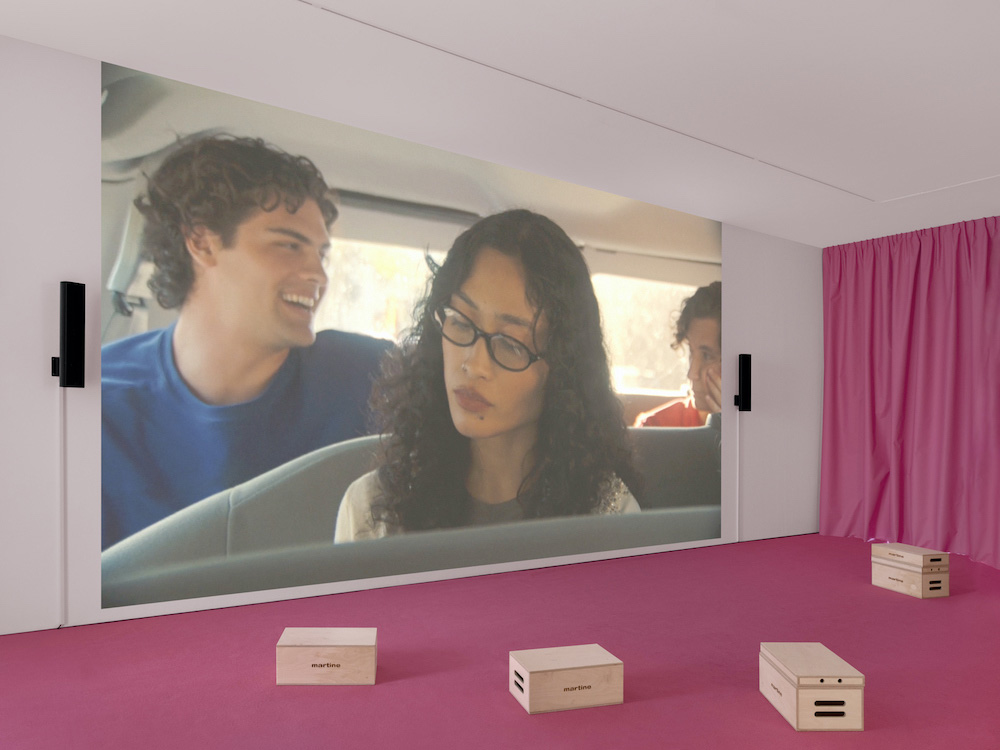
From Robert Ryman and Lorna Simpson to Mary Ramsden, Martine Syms and Nicola Turner, the strongest London route during Frieze week begins outside the fair.
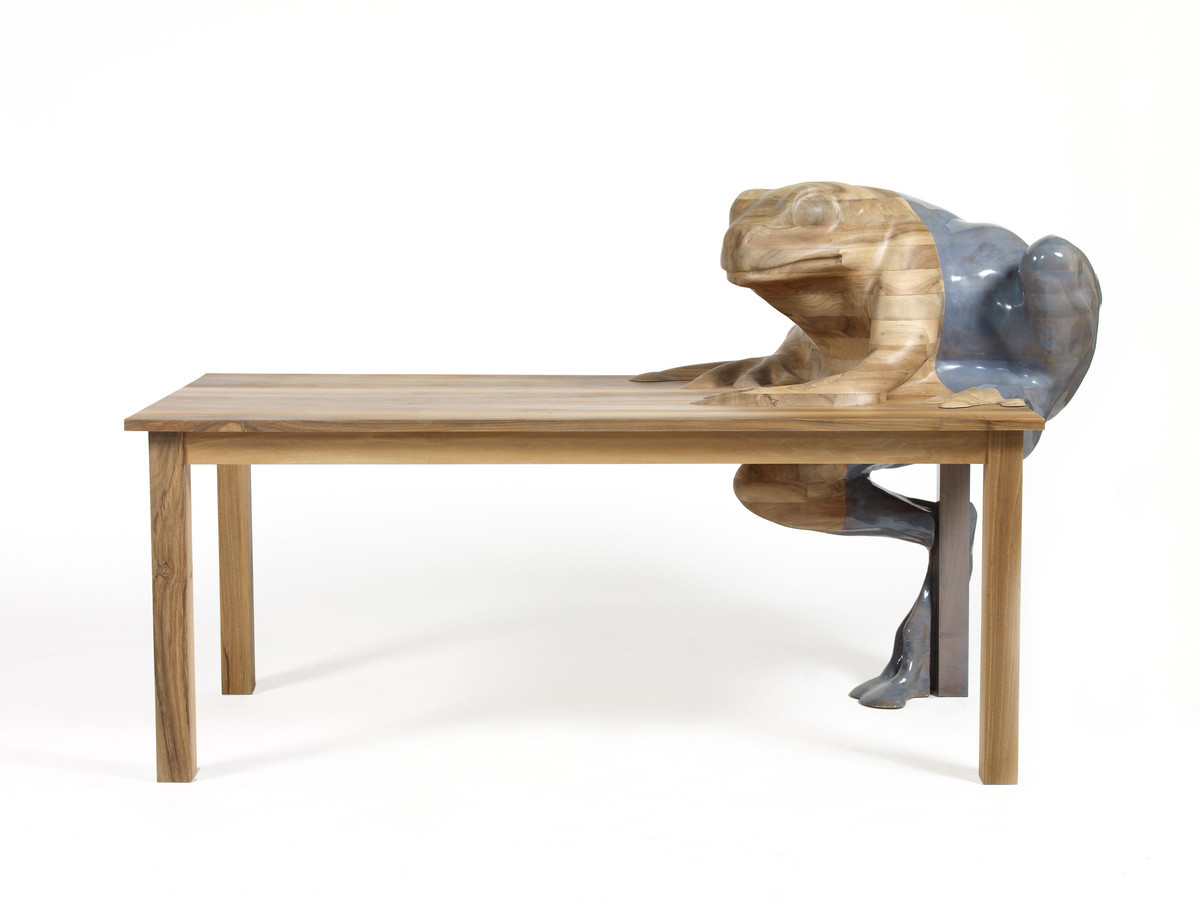
From the Polder Sofa to Frog Table and 300 coloured vases, Hella Jongerius has spent three decades proving that industrial design can retain craft, variation and material intelligence.