
October 20, 2026
Exhibitions
Exhibitions

Paris Internationale returns with 56 galleries, a new Canal Saint-Martin venue and a model built around discovery. Here is how collectors should use it.
At PAMM, forty works drawn largely from Craig Robins’s holdings reveal what happens when a collector follows one artist for decades — and when private conviction becomes public scholarship.
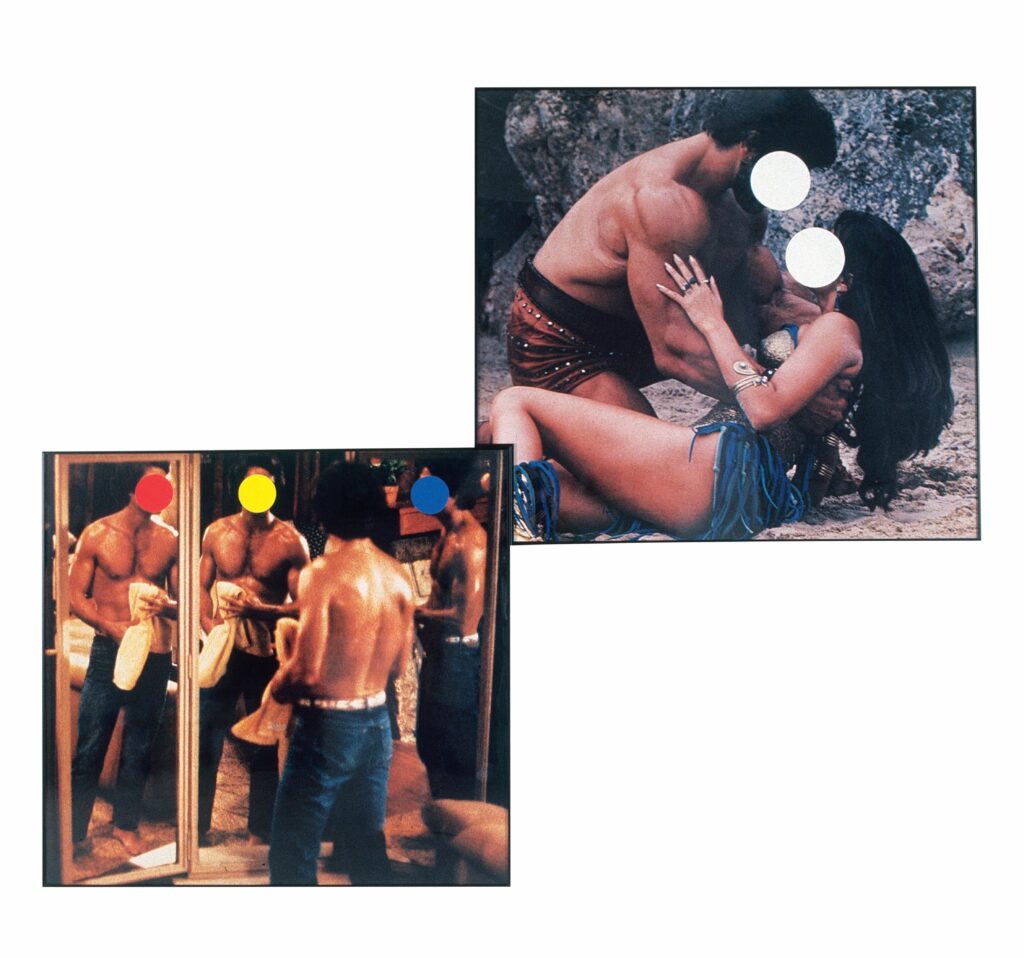
There is a moment when a private collection stops behaving like an accumulation of possessions and begins to function like an argument. That moment is unusually visible in Miami this week. At Pérez Art Museum Miami, John Baldessari: The End of the Line brings together forty works spanning painting, photography, video and installation, drawn largely from the holdings of Craig Robins. The exhibition is the first major survey of Baldessari in South Florida and the first United States iteration of a project previously shown in Argentina and Uruguay. Yet its significance for collectors lies partly outside the conventional retrospective story. It shows, with museum-scale clarity, what can happen when one collector follows one artist for long enough.
Robins began buying Baldessari in 1993. The introduction came through curator Bonnie Clearwater, who had noticed that the young Miami collector was already acquiring artists shaped by Baldessari's teaching, among them Mike Kelley and David Salle. Robins has recalled that he made an unusually ambitious decision at that first encounter: he bought three works, including the text painting Clement Greenberg (1966–68). The purchase did not become an isolated trophy. It became the beginning of a relationship and, eventually, a group of roughly forty-five works extending from Baldessari's foundational conceptual period to the end of his life.
Most collecting advice is built around selection: find the best work you can, establish provenance, understand condition, resist fashion, buy with conviction. Those principles matter. They say much less about what comes after the first successful acquisition. If an artist has already entered a collection, should the next purchase broaden the list of names or deepen the representation of the artist already there?
Robins's Baldessari holdings offer one answer. Depth is not the same thing as repetition. A deep collection earns its coherence when successive works disclose different stages of an artist's thinking, different materials, different problems, even different failures. That is particularly apt in Baldessari's case because his career was a sustained attack on the notion of a fixed artistic signature. He began as a painter in Southern California, then progressively folded language and photography into the work. In 1970, in the now canonical Cremation Project, he burned much of the painting he had made between 1953 and 1966 and converted the ashes into commemorative objects. The act was less a theatrical rejection of painting than a change in the terms of artistic production: the idea, the instruction, the photograph, the caption and the system could all carry as much weight as the hand-made object.
Clement Greenberg, one of Robins's earliest purchases, sits at precisely that fault line. Baldessari commissioned a professional sign painter to transfer words associated with the critic who had become synonymous with modernist formalism. The result looks almost anti-expressive: language presented as painting, fabrication separated from authorship, aesthetic judgement turned into an object whose making was deliberately outsourced. For a collector trying to represent Baldessari's historical importance, it is difficult to imagine a more consequential starting point.
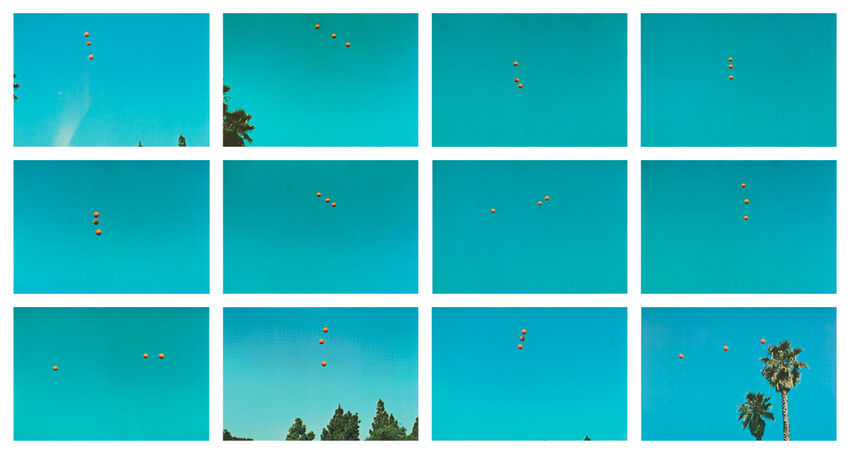
The advantage of collecting across decades becomes even clearer in the photographic work. Throwing Three Balls in the Air to Get a Straight Line (Best of Thirty-Six Attempts) (1973) begins with a rule so simple it could be mistaken for a game. Baldessari throws three orange balls against a blue sky, photographs the attempts, and accepts chance as a collaborator. The work is serial, procedural and comic; its title already contains the method, the desired result and the admission that perfection is improbable. The image is not merely a picture of balls in the air. It is evidence that an idea has been tested.
By the 1980s and 1990s Baldessari's source material had expanded into a vast private archive of film stills, television images, newspaper photographs and other reproductions. Faces were blanked by circles; fragments were enlarged or cropped; apparently unrelated images were forced into relationships. In later works the mechanisms became more elaborate, but the underlying question remained remarkably consistent: how quickly do viewers manufacture meaning from the visual evidence placed in front of them?
That continuity matters. A collection containing only a famous dot-covered photograph might capture the artist's recognisable visual language. A collection that also contains the early text paintings, the rule-based photographic experiments and later composite works can demonstrate why those images emerged at all. The distinction is the difference between acquiring an icon and constructing an account.
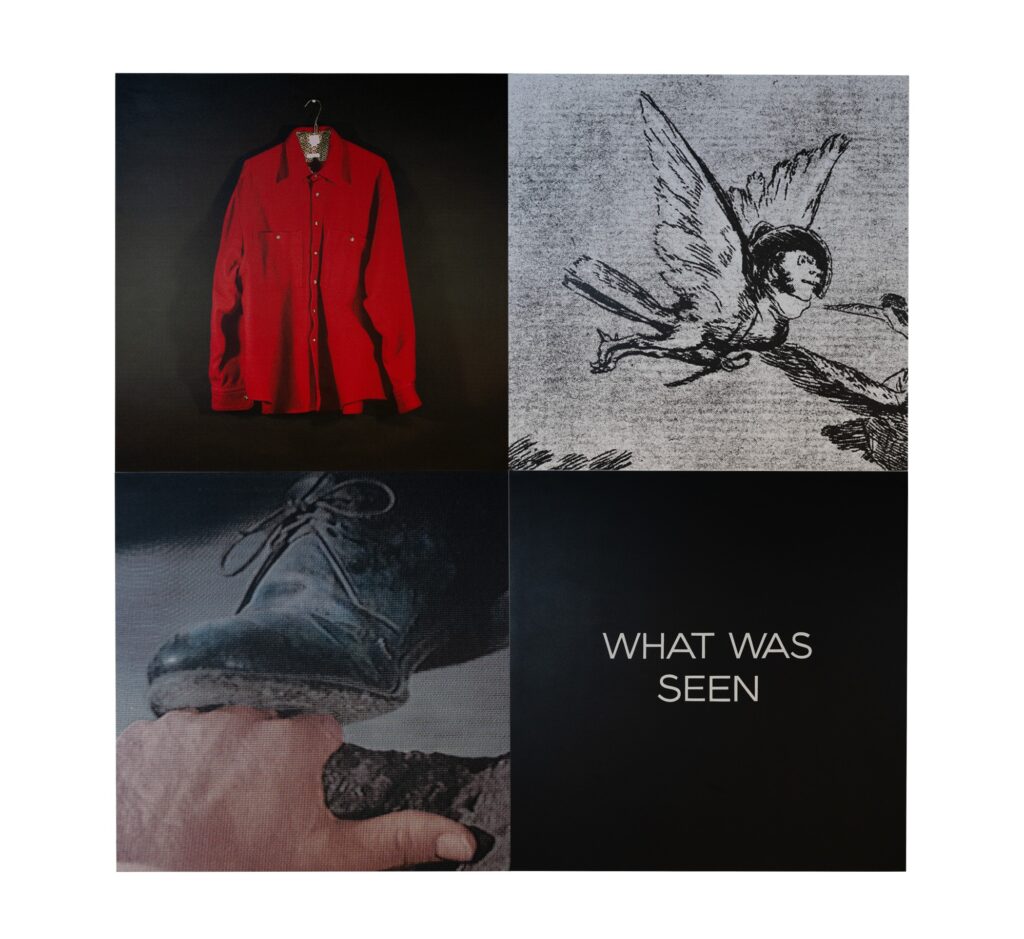
Collectors often describe themselves as custodians, patrons or connoisseurs. A collection of this kind suggests another role: editor. Editing does not mean controlling an artist's story. It means deciding which objects, when placed together, allow that story to be read with greater precision. In a deep collection, adjacency becomes a form of knowledge. An early work changes the way a late one is seen; an apparently minor experiment can explain the mechanics of a masterpiece; a work that once seemed anomalous can become the hinge between two periods.
This is also where the romance of friendship between artist and collector needs a little resistance. Personal access can produce extraordinary opportunities, but friendship alone does not create a historically convincing collection. It can just as easily encourage sentimentality, duplication or blind spots. What distinguishes the Robins holdings is that they have been subjected to the discipline of exhibition: first in Buenos Aires, then in Uruguay, and now at PAMM, where an institutional framework tests whether the private selection can carry a public narrative. Curator Karen Grimson and the PAMM team are not simply hanging a collector's favourites. They are using works to articulate a half-century of changes in Baldessari's practice.
That public test is important. A collection becomes more culturally consequential when it can survive the translation from domestic or corporate space to museum galleries without losing coherence. It must be documented. It must contain works strong enough to sustain comparison. It must be capable of lending, research and reproduction. Ideally, it should make something visible that a scattered group of unrelated loans would make harder to see.
There is another reason the exhibition feels unusually complete in Miami. Baldessari's relationship with the city was not confined to Robins's walls. In 2014 he produced permanent public commissions for the Miami Design District, including Fun, placing his deadpan treatment of popular imagery onto the architecture of the neighbourhood. PAMM itself holds three works by the artist. The new exhibition therefore brings together several strands of the same local history: a collector's long commitment, an artist's public presence and a museum's institutional responsibility.
Robins's larger collection now exceeds 1,700 works of modern and contemporary art and design. The Baldessari concentration sits inside that broader field, but it is useful precisely because it refuses the logic of one-name-per-slot collecting. Robins has said that his aim was not simply to own one example of every artist he admired, but to watch careers unfold. That approach carries costs: financial concentration, storage, conservation and the opportunity cost of not buying something else. It also creates the possibility of understanding an artist in time rather than as a brand.
Private collections enter public history in many ways. They are donated intact, dispersed at auction, divided by inheritance, placed in foundations or gradually absorbed into museums. Long before any of those endings, however, a collector can influence scholarship simply by maintaining a coherent body of work, making it available to curators and researchers, preserving documentation and allowing relationships between objects to be seen.
The End of the Line is therefore not a lesson in buying forty-five works by the same famous artist. The number is the least interesting part. The lesson is that concentration only becomes meaningful when each acquisition enlarges the story the collection can tell. The second or tenth work should not merely confirm the first choice; it should complicate it.
That is the threshold between accumulation and stewardship. A collection begins as a set of private decisions. Given enough patience, rigour and access, those decisions can become an archive. And on rare occasions, as this exhibition demonstrates, the archive becomes substantial enough for a museum to turn it into history.
John Baldessari: The End of the Line is on view at Pérez Art Museum Miami from 20 August 2026 to 9 May 2027.
Paris Internationale returns with 56 galleries, a new Canal Saint-Martin venue and a model built around discovery. Here is how collectors should use it.
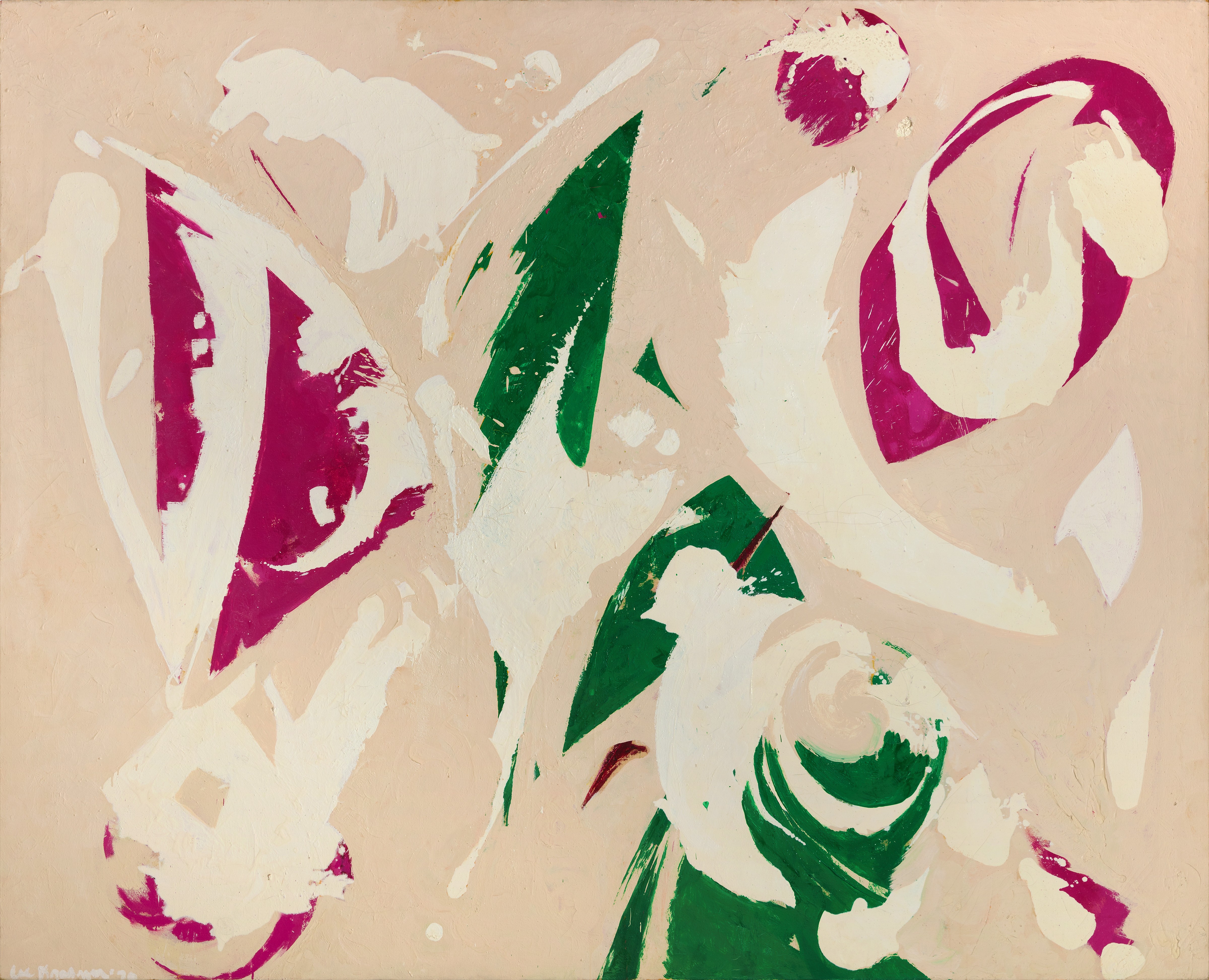
Ibrahim Mahama, Lee Krasner, Oscar Murillo, Tracey Emin and more: the exhibitions that turn Art Basel Paris week into something larger than a fair.

From a £5 million Brueghel and three major Alice Neel sales to George Rickey, global modernism and a £675,000 Triceratops skull, Frieze Masters rewarded collectors who looked beyond categories.