
November 5, 2026
Articles
Articles
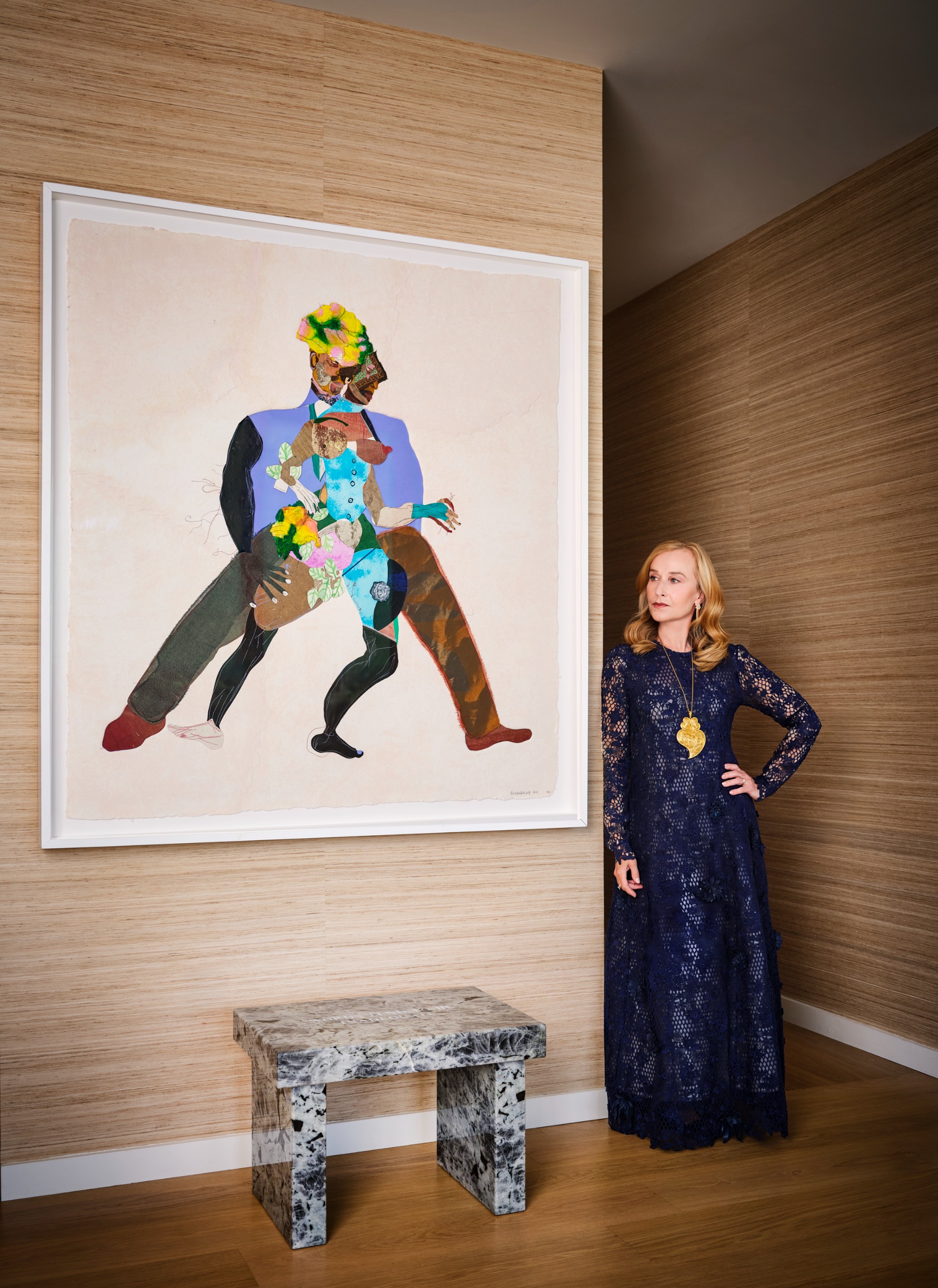
Kelly Behun’s West Chelsea apartment for former US ambassador Randi Charno Levine shows how a serious contemporary collection can grow from relationships, patronage and a new Joana Vasconcelos commission.
There are paintings that announce themselves through size, and others that make scale feel like an unnecessary distraction. Tony Huynh belongs to the second group. His new pictures at Galerie Christian Lethert in Cologne are small, oil-on-wood worlds of animals, journeys, domestic interiors and quiet solitude. They look approachable at first, even disarmingly simple. Stay with them, however, and their modest dimensions begin to contain disquieting distances: a train that seems not quite to arrive, a person enclosed by the geometry…
There are paintings that announce themselves through size, and others that make scale feel like an unnecessary distraction. Tony Huynh belongs to the second group. His new pictures at Galerie Christian Lethert in Cologne are small, oil-on-wood worlds of animals, journeys, domestic interiors and quiet solitude. They look approachable at first, even disarmingly simple. Stay with them, however, and their modest dimensions begin to contain disquieting distances: a train that seems not quite to arrive, a person enclosed by the geometry of a bed, a sheep standing beneath a coloured moon.
Heaven or Las Vegas, on view from 6 November to 18 December 2026, is the American painter’s first solo exhibition in Europe and his first with the gallery. The title names extremes, but the paintings are interested in the states in between. They are not surrealism in the familiar sense of an unexpected object interrupting a normal scene. Their logic is stranger and quieter. Nothing particularly impossible needs to happen for a scene to feel outside ordinary time. The work’s appeal depends on that understatement; its emotion remains more complicated than its iconography initially suggests.
Huynh paints in oil on wood, often presenting the completed image in a frame designed as part of the work. This gives the pictures something of the self-possession of devotional panels or private keepsakes. Their colour is controlled rather than merely bright. Blue, violet, brown and ochre recur in arrangements that can seem decorative until a darker note enters. A small painting therefore does not become a small idea. The limited scale concentrates the relationship between an individual motif and the overall shape of a composition.
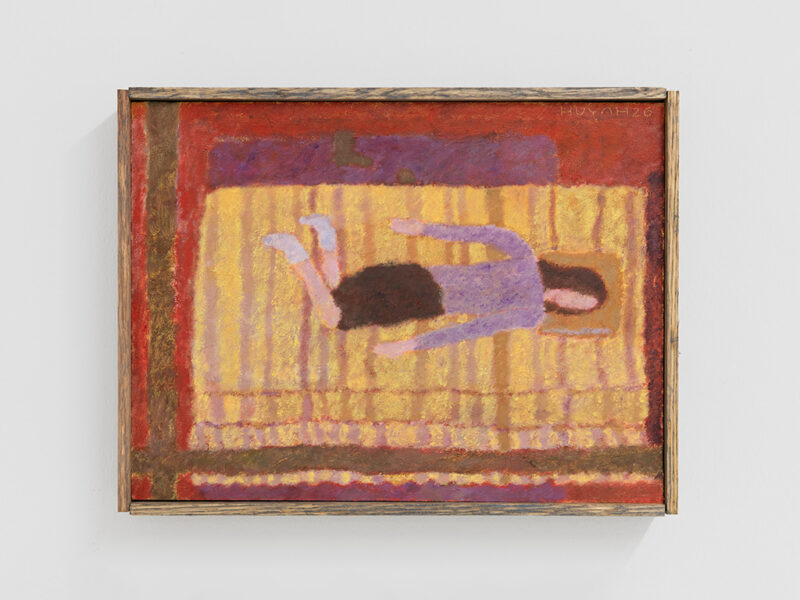
Consider As Days Go By (2026), a figure viewed from above while lying across a bed. The room refuses descriptive detail, and the bed becomes a set of coloured bands or a second picture containing the sleeper. There is a tenderness to the scene, yet the angle and compression also place a distance between observer and subject. We see a person but are not invited into a simple biography. The painting quietly withholds what a larger narrative composition might supply.
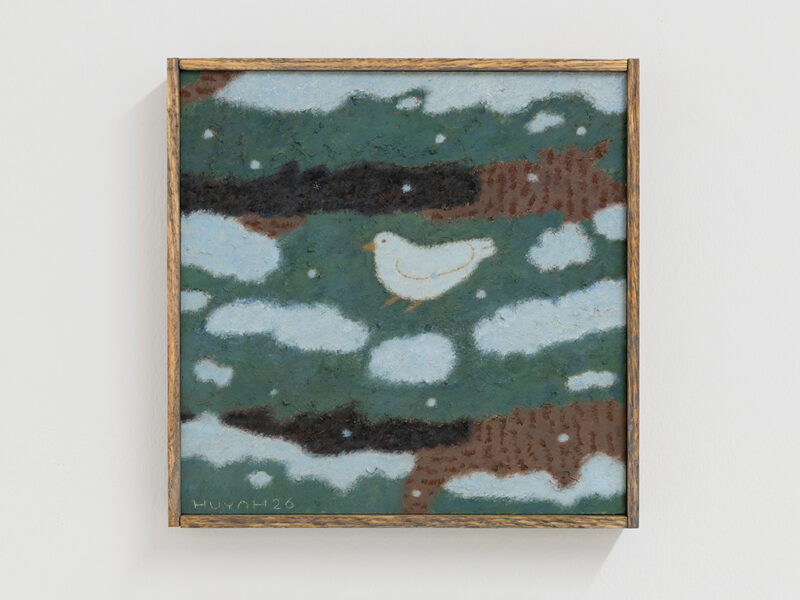
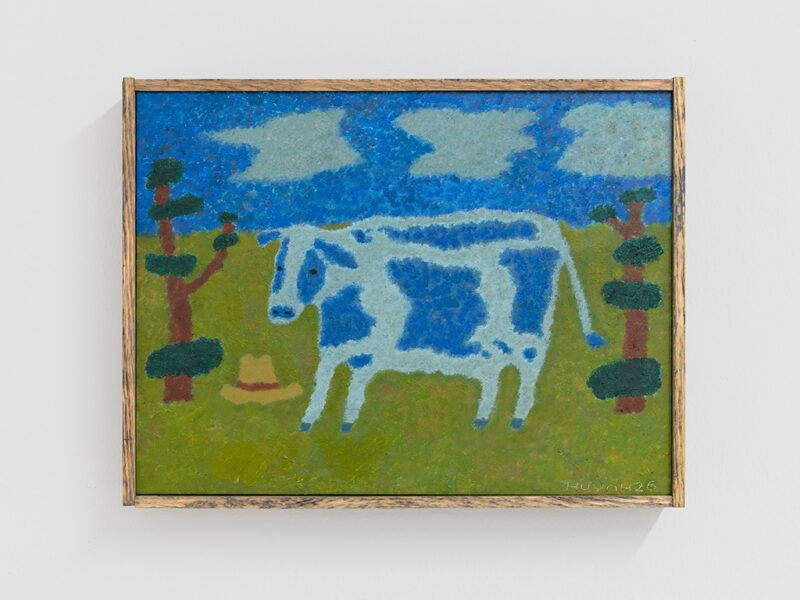
Huynh’s animals are particularly effective because they test how readily viewers will supply stories. Lonesome Dove (2026) gives its bird a delicate presence amid stylised trees and cloud-like pale patches. Midnight Cowboy (2026) places a pale cow in saturated fields beneath a powerful blue sky. The titles are playful, but the animals are not simply jokes. The pictures compress a possible fable into a few carefully calibrated marks. They retain the flatness of an invented scene while suggesting an emotional atmosphere just beyond the image.
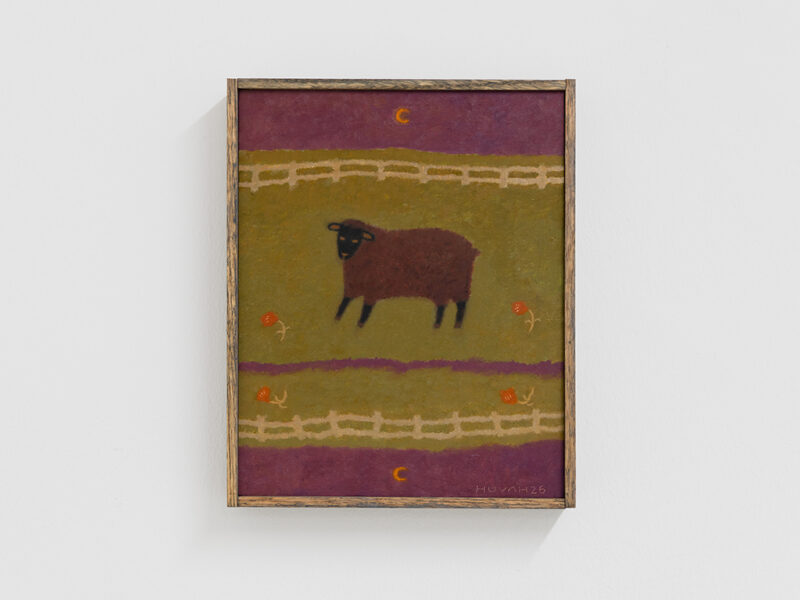
The Stranger (2026) builds an equally deliberate world around an isolated dark sheep, its form suspended between a night sky and patterned ground. Without complicated symbolism, the image can suggest estrangement, individuality or even an unspoken affinity with the animal’s self-contained existence. None of these meanings is fixed. What matters is the space between the clarity of the figure and the uncertainty of the story.
The Cologne gallery describes the paintings as informed by both established and outsider art histories, as well as techniques associated with Japanese printmaking. One can see why. Huynh is willing to let a silhouette carry the weight of a picture, to reduce depth without abandoning space, and to place apparently naïve forms within a tightly organised field. Yet it would be reductive to describe the work as naïve. Simplicity here looks chosen rather than unexamined.
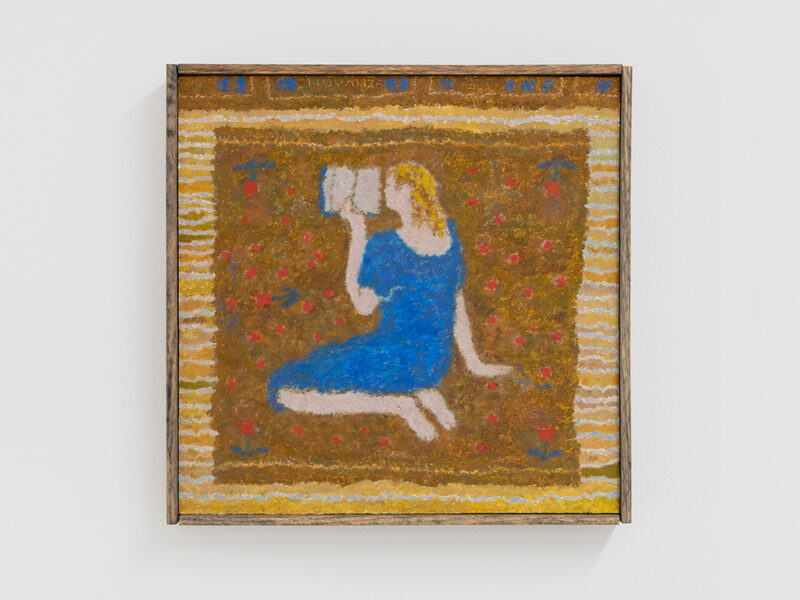
The distinction can be seen in Novella (2026), where the blue of a seated woman’s dress establishes a visual rhythm against an ochre ground. The painting operates through careful relationships between enclosing line, colour and pattern. Its emotional effect is difficult to separate from those formal decisions. This is the opposite of an artist hiding uncertainty behind a complicated narrative. Huynh pares scenes down until the precision of the image and the ambiguity of the mood reinforce one another.
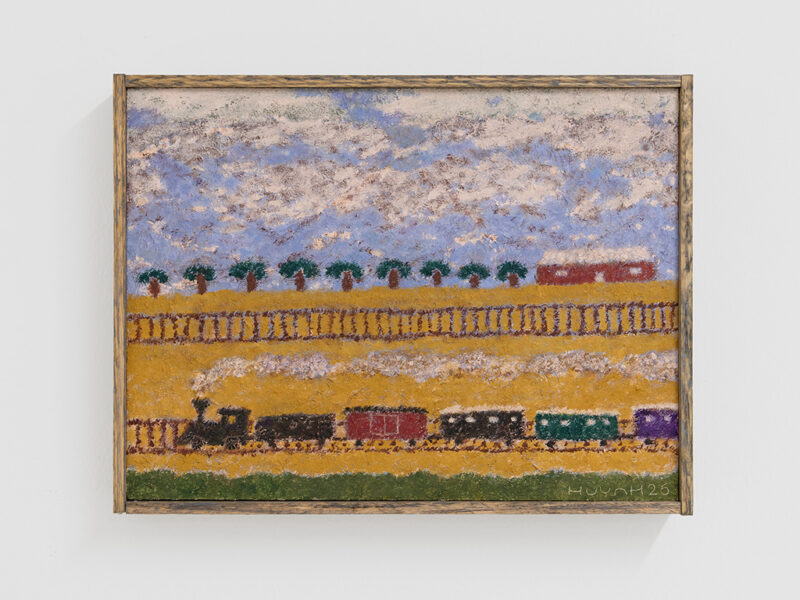
The movement of a train across Follow the Rail May Take You (2026) seems like a promise of direction. The work offers tracks, carriages and a horizon, the most familiar components of a journey. But the image resists turning that journey into a destination. The rail becomes a strong horizontal structure, a means of ordering the picture, while the story seems to remain open. There is a similar paradox in Huynh’s larger emotional vocabulary: his paintings depict movement, yet feel still; they contain recognisable objects, yet remain hard to place in time.
This is one reason the paintings deserve to be encountered as a series rather than isolated as instantly shareable images. A cow, a tree, a traveller or a bed can look whimsical alone. In company, those subjects begin to establish a consistent set of questions about solitude, memory and the distance between personal narrative and public image. A gallery exhibition gives us the chance to see the painter test that vocabulary rather than simply repeat an attractive motif.
A small painting asks for a different pace. Rather than begin with subject identification, look at the transition between fields of colour. Where does a contour become an edge of paint rather than an edge of a thing? What does the grain of the wooden support allow? Is the frame an extension of the pictorial architecture, or does it deliberately interrupt the scene? In works using relatively restrained shapes, such decisions are not secondary details. They create much of the experience.
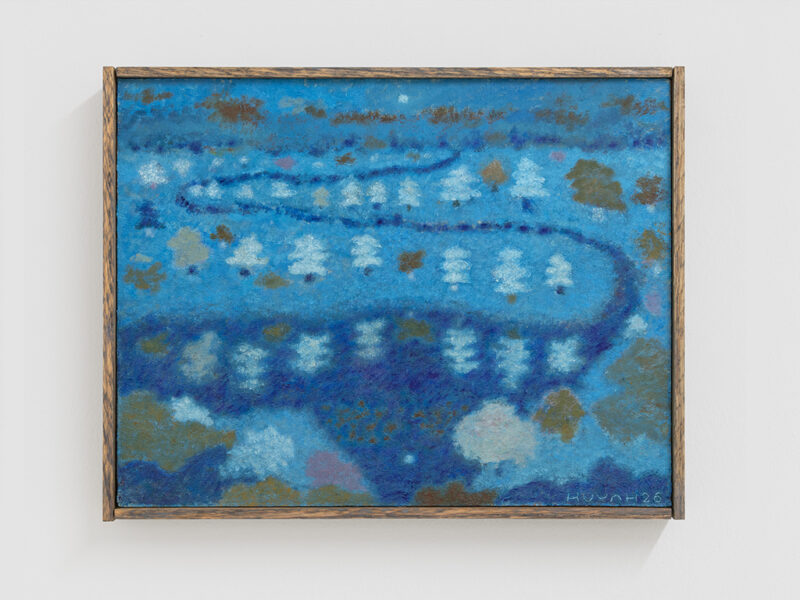
The Bends (2026), dominated by blues and softened passages of colour, is useful in this respect. It does not rely on a protagonist or anecdote. Its atmosphere emerges from the organisation of marks and the relationship between density and open space. That gives a clue to the seemingly figurative paintings as well: behind their accessible images lies an attention to the physical behaviour of paint.
For collectors drawn to smaller formats, Huynh’s works raise questions that can be more useful than simply whether a picture fits easily into a home. The intimate scale permits close looking, but it also makes small variations in condition, varnish, framing and surface crucial. If the frame forms part of the artist’s intended presentation, its authorship and conservation need to be documented. A chipped original frame is not necessarily equivalent to a replaceable commercial frame.
Collectors should also compare the strength of imagery across the group. Does a painting sustain attention after its charming subject has been absorbed? Are variations in palette and compositional rhythm meaningful, or has one repeated device become a formula? The decision to acquire should rest on the specificity of the individual work as much as on an emerging artist’s career trajectory. The gallery notes that an English/German 60-page exhibition catalogue accompanies the show; documentation of this kind can help preserve the context in which the work first appeared.
For an artist moving between American and European audiences, the first substantial exhibition in a new region is more than a line on a résumé. The works are encountered outside the relationships, studio visits and critical conversations that may already have shaped their reception at home. Viewers in Cologne can evaluate the paintings on their own terms, with little obligation to accept an established narrative. That distance matters for a young painter whose pictures already invite interpretation. It also gives the presenting gallery an opportunity to explain the work patiently, through installation, informed discussion and sustained attention rather than a single sales announcement. The result can be a richer kind of international introduction.
The relatively small gallery in Cologne provides a suitable setting for a body of work that could be overshadowed in a more spectacular context. It is also the kind of international exhibition that is easily missed by collectors whose calendars are arranged around major fairs. Yet the most interesting artistic developments are not always announced by grand scale or an institutional endorsement. Sometimes they emerge from the sustained refinement of a pictorial language that appears almost effortlessly familiar.
What Huynh offers in Heaven or Las Vegas is not an illustrated catalogue of loneliness. It is a way of allowing the ordinary world to remain emotionally unfinished. The paintings’ directness is real; so is their hesitation. Between the two lies their particular strength.
Tony Huynh: Heaven or Las Vegas — Galerie Christian Lethert, Cologne. 6 November–18 December 2026.
Source notes: exhibition dates, works and materials checked against the presenting gallery. This article is an independent research-based exhibition feature, not a claim of a first-hand visit.
Further reading: www.christianlethert.com · www.artsy.net
Kelly Behun’s West Chelsea apartment for former US ambassador Randi Charno Levine shows how a serious contemporary collection can grow from relationships, patronage and a new Joana Vasconcelos commission.

The new Dasha Shenkman Focus Fund has placed three Okiki Akinfe works into Abbot Hall. Its real significance is a model of private patronage that creates public institutional value early.
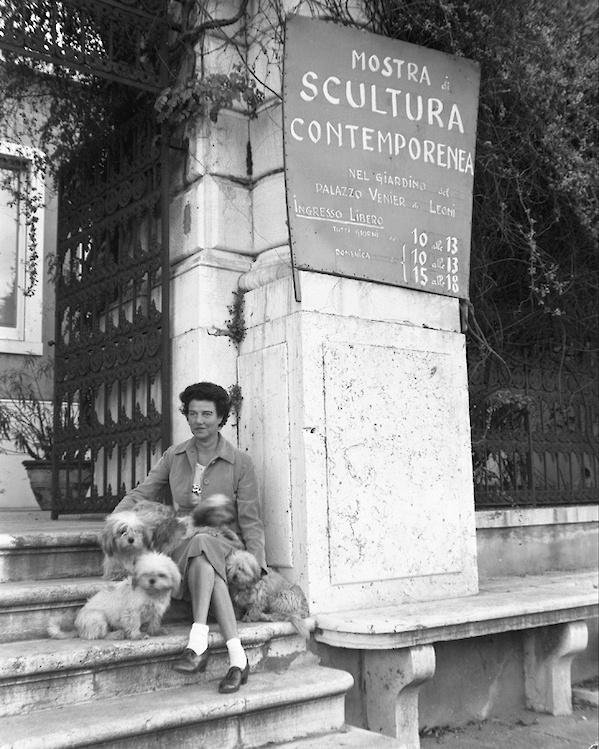
At Palazzo Venier dei Leoni in Venice, Peggy Guggenheim made modern art part of daily life—and left a model for the home as a living collection.