
October 18, 2026
Exhibitions
Exhibitions

From a £5 million Brueghel and three major Alice Neel sales to George Rickey, global modernism and a £675,000 Triceratops skull, Frieze Masters rewarded collectors who looked beyond categories.
A four-decade London apartment collection coming to Dreweatts combines Regency furniture, antiquities, modern art and deep provenance into a masterclass in cross-category collecting.
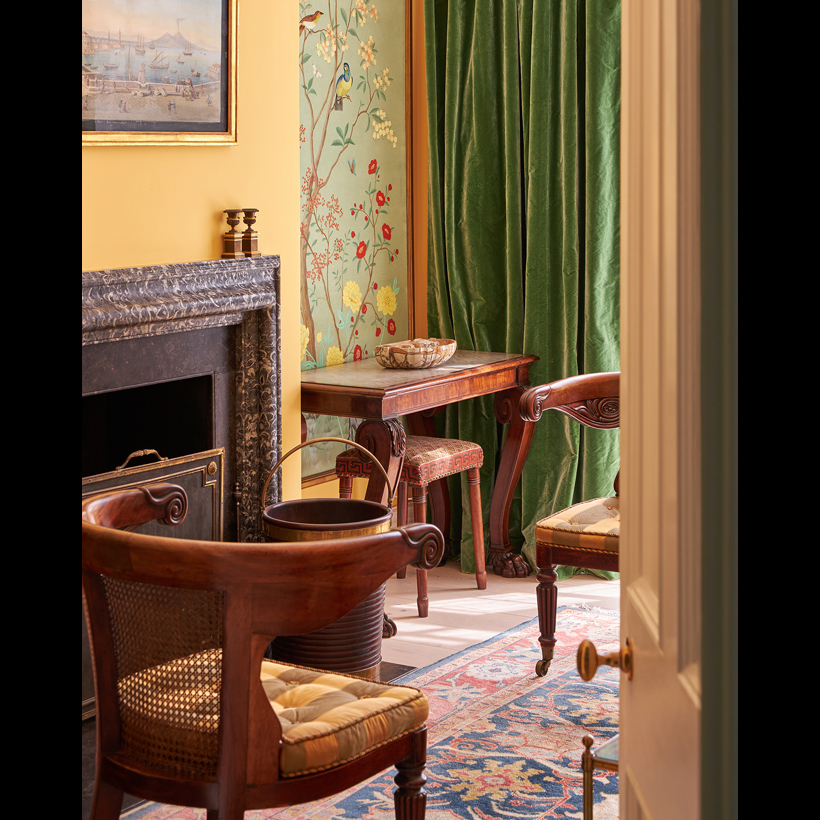
A London apartment overlooking one of the city’s great parks is being dispersed at Dreweatts after four decades of collecting. The owner is anonymous, but the rooms tell a remarkably specific story: Regency furniture, Grand Tour references, antiquities, modern art and shelves of research assembled into a home where category mattered less than connoisseurship.
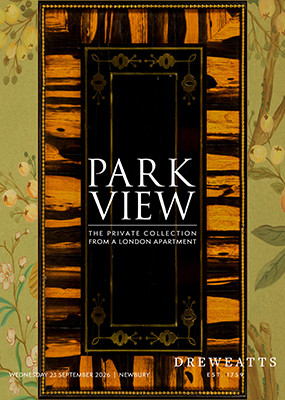
There is a kind of collection that makes most sense before it is separated into lots. Park View: The Private Collection from a London Apartment, coming to Dreweatts on 23 September, is one of them. The catalogue can describe a George Oakley-attributed bookcase, a Sinhalese writing table, a porphyry clock or a Sidney Nolan work individually. The apartment photographs explain why the owner wanted all of them.
Dreweatts says the collection was built over four decades through careful and extensive research. The evidence is visible in the library, where catalogues and monographs line the walls. Provenances lead back toward collections associated with the Dukes of Newcastle at Clumber Park, the Viscounts Bearsted at Upton House and the Earls of Rosse at Birr Castle. The furnishings repeatedly return to the architectural language of the Grand Tour and British Regency design.
Yet this is not a period room. Modern and contemporary art, antiquities and objects from beyond Britain are allowed into the same conversation.
The usual advice to new collectors is to focus. That is sensible when it means learning deeply enough to recognise quality. It becomes limiting when focus is confused with category. Park View demonstrates another possibility: the collector’s field can be conceptually coherent while materially broad.

The connective tissue here is historical curiosity. Grand Tour culture offers a route from classical form into Regency furniture, from architecture into objects made from porphyry or Blue John, from archaeological taste into paintings of Italian landscapes. Once the logic is understood, an English armchair and a Greek terracotta can belong to the same collection without pretending to be the same kind of thing.
This is useful for collectors now because the market has become increasingly specialised. Auction departments, fairs and dealer networks divide objects efficiently into categories. Homes do not have to obey those divisions.
One of the most telling images is not a single object but the room of books. Dreweatts emphasises the collector’s research, and the library makes that scholarship visible. This was not acquisition by mood alone.
The highest-estimated piece, a Regency gilt-brass mounted and inlaid ebony and calamander breakfront bookcase attributed to George Oakley, circa 1815, is estimated at £60,000–90,000. The form draws on Greek Revival vocabulary and sits naturally inside a collection interested in the way archaeology and travel shaped British design.
Other highlights carry the same historical chain. A pair of Regency mahogany and caned klismos library armchairs, possibly by Thomas Chippendale the Younger, is estimated at £8,000–12,000. A pair of George III Gothic library armchairs attributed to Gillows, possibly after a James Wyatt design, is estimated at £20,000–30,000.
Scholarship is one of the few collecting advantages that can improve every object already in the room.
Provenance is often discussed as a vertical chain—owner after owner, date after date. In a domestic collection it can work horizontally too. Objects with histories connected to important country-house collections create an invisible network across the apartment.
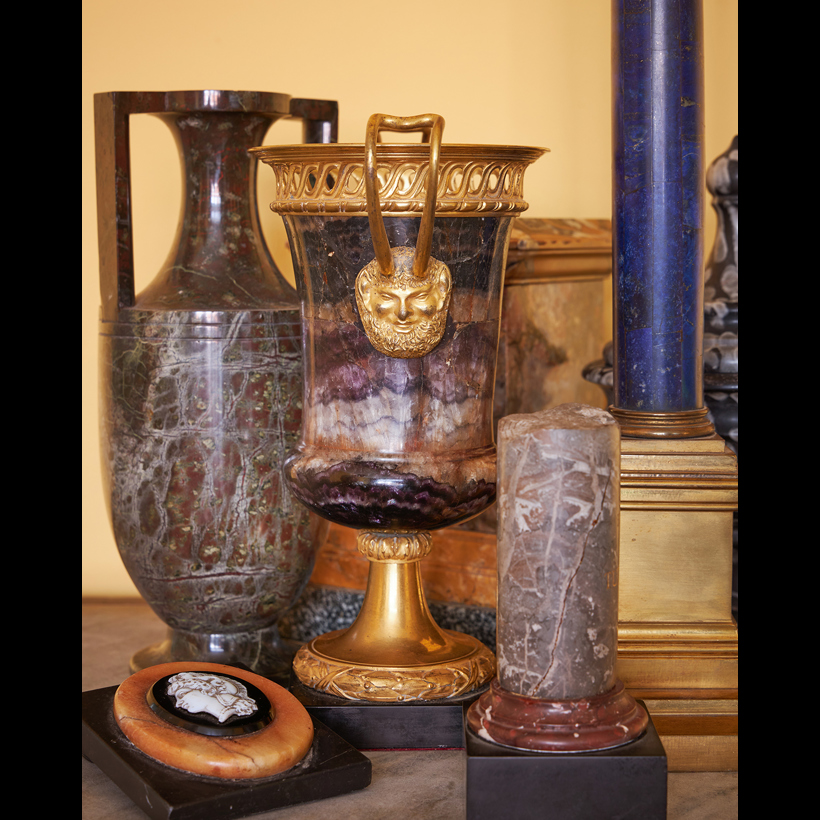
That network matters because it gives the collector more than reassurance about authenticity. It situates an object inside previous systems of taste. A piece once associated with a great British collection carries information about how it was valued, displayed and understood before arriving in London.
For buyers at the September sale, provenance may therefore be as important as decorative compatibility. The apartment is being dismantled, but individual objects can carry pieces of its research culture into new homes.
The sale also demonstrates something healthy about cross-category collecting: significant objects appear at very different price levels. Alongside the £60,000–90,000 bookcase are a French Empire porphyry and marble clock at £3,000–5,000; a Sinhalese writing table at £3,000–5,000; a pair of Blue John urns at £5,000–8,000; and a Boeotian terracotta figure at £800–1,200.
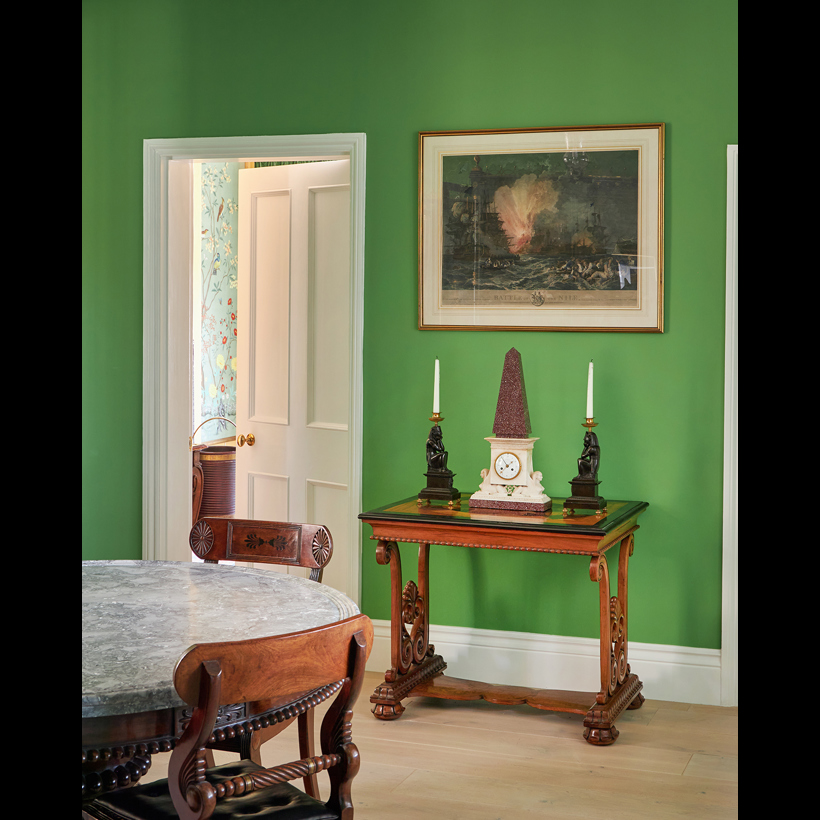
In a well-built room, the hierarchy does not need to follow the estimate. A small archaeological object can carry the conceptual theme of the collection more strongly than the most expensive piece. This is one reason collected interiors are often more interesting than rooms assembled through luxury procurement: money is only one of several organising forces.
Sir Sidney Nolan’s Bird and Dancers, estimated at £2,000–3,000, is an important inclusion because it stops the collection from becoming antiquarian nostalgia. Modern work can change the tempo of a room. It brings a different mark, scale and visual psychology to furniture shaped by historical revival.
The same is true of Simon-Joseph-Alexandre-Clément Denis’s A Turkish Capriccio, estimated at £15,000–25,000. Rather than treating paintings as wall-filling support for furniture, the collection uses them to extend its ideas about travel, imagined place and the history of looking at the Mediterranean and Near East.
Every single-owner sale contains an unavoidable paradox. The auction is valuable because a collection had coherence; the commercial process then breaks that coherence into separate purchasable units. For buyers, the opportunity is to remember the whole while evaluating the part.
Dreweatts says the owner is moving toward a quieter life in the south of France. That detail gives the sale a natural endpoint rather than a dramatic one. Collections do not have to remain intact forever to have been successful. They can accomplish something for the collector over decades, then redistribute knowledge and objects into other homes.
The strongest acquisitions from Park View will probably be those bought with the same seriousness that built the original collection: not because they once belonged in a beautiful London apartment, but because the buyer understands why the object is good on its own terms.
That is ultimately the lesson of the rooms. A broad collection does not need to be random. It needs an intelligence capable of making connections. Here, classical archaeology informs Regency design; provenance informs furniture; travel informs painting; books inform everything.
Single-owner auctions are seductive because the original collection supplies instant context. A chair looks better beside the bookcase it lived with; a small antiquity gains authority from shelves of scholarship; provenance across the room creates an atmosphere of accumulated judgment. Buyers should enjoy that context without allowing it to replace object-level scrutiny. Condition, attribution, construction, restoration and comparable examples still matter. A distinguished former room cannot repair a compromised object.
There is also a useful distinction between acquiring a piece that genuinely advances one’s own collection and acquiring a souvenir of someone else’s taste. The strongest purchase from Park View will be an object that continues to make sense after the catalogue photograph is forgotten. That might be the George Oakley-attributed bookcase, but it could equally be a modest terracotta or a £2,000–3,000 Nolan if that work unlocks a meaningful line of inquiry for the buyer.
The contemporary collector increasingly encounters art, furniture and design in the same fairs, auction weeks and homes. That convergence can become superficial when everything is marketed as “collectible”. Park View shows the more rigorous version: categories are crossed because research reveals historical and visual relationships, not because a trend demands mixture. The difference is scholarship.
For ARTCOLLECTORHOMES, this is the useful benchmark. A home does not become culturally interesting by filling every surface with expensive objects. It becomes interesting when the owner has developed enough knowledge to make connections that would not exist without that particular collection. The apartment may now be dispersed, but the method behind it remains intact—and portable.
In a market that often pushes collectors toward ever narrower departments, Park View is a reminder that the home can still be the place where categories are recombined into a personal history of looking.
From a £5 million Brueghel and three major Alice Neel sales to George Rickey, global modernism and a £675,000 Triceratops skull, Frieze Masters rewarded collectors who looked beyond categories.

Frieze London closed with sold-out emerging booths, meaningful institutional acquisitions and selective blue-chip buying. The real story was not a boom, but a market rewarding specificity.

Nearly 150 works from RM’s collection meet SFMOMA in a major exhibition of Korean modern and contemporary art. Its real lesson is how a private collection develops a coherent eye.