LATEST NEWS:
Erna Rosenstein
Austria’s first major Erna Rosenstein retrospective traces six decades of a multimedia practice shaped by memory, the Shoah and postwar Poland.
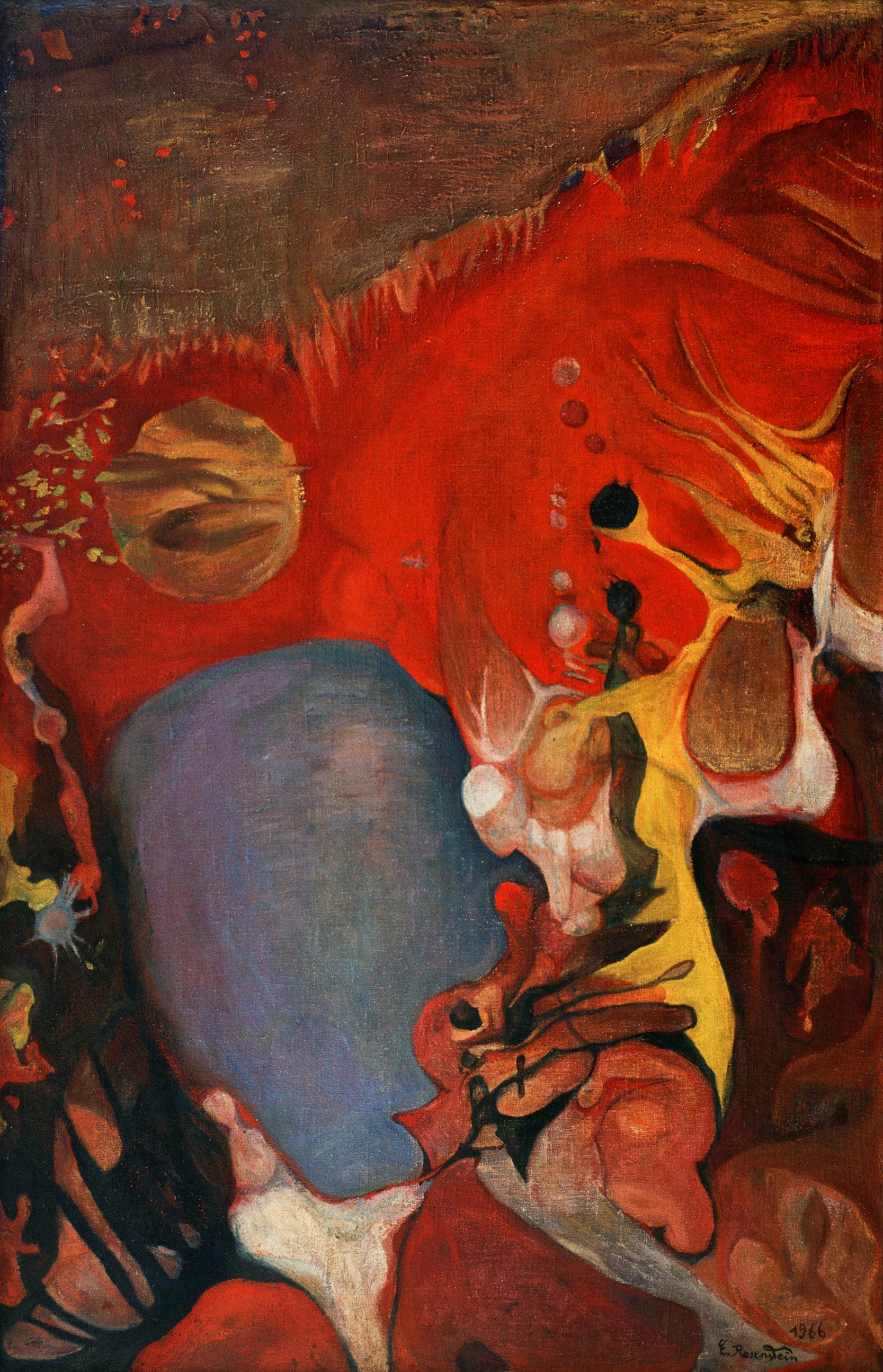
On the Other Side of Silence is the first comprehensive Austrian retrospective devoted to Erna Rosenstein, a key figure of the Polish postwar avant-garde. Approximately eighty works in the Orangery of the Lower Belvedere span six decades of painting, drawing, assemblage and poetry, presenting memory not as a stable historical account but as an active and continually reconstructed process.
Rosenstein’s life was marked by the Shoah and by political upheaval in Poland. She spent two formative years in Vienna in the early 1930s, studying at the Women’s Academy and witnessing the February uprising of 1934. Works from this early period were subsequently lost or destroyed during persecution in Nazi-occupied Poland.
After the war, Rosenstein developed an expressive language through which collective violence, complicity and personal trauma could be addressed without yielding to official artistic doctrine. During the Stalinist era she resisted Socialist Realism, maintaining a Surrealist-inflected practice rooted in subjective experience. The murder of her parents remained a recurring point of return, but the exhibition also emphasises the artist’s humour, invention and refusal to allow grief to become the sole frame through which her work is read.
From the late 1950s biomorphic and increasingly abstract forms entered her paintings, yet figuration never disappeared entirely. In her assemblages, found and discarded objects become poetic constellations, while enigmatic titles establish a close relationship between image and language. The exhibition presents these shifting approaches as evidence of an artist determined to find forms for experiences that often exceeded conventional representation.
Image credit: Erna Rosenstein, The Burning of the Witch, 1966. Zachęta – National Gallery of Art, Warsaw. The Estate of Erna Rosenstein – courtesy of Foksal Gallery Foundation and Hauser & Wirth. Image supplied by the Belvedere press office for reporting on the exhibition.

.jpg)
.jpg)



.webp)